Emphasize your weight loss triumphs and work towards making them more frequent
Find a weight loss "buddy," club, or support group. This will help you stay with your weight loss program.
Use mustard on your sandwiches instead of mayonnaise. Mustard has no fat & very little calories while Mayo, is loaded with fat. If you just don’t like the taste of mustard, find a low-fat alternative, but avoid mayonnaise at all costs.
Weigh yourself each week. Don't be worried about small daily changes in your weight. You shouldn't lose more than 1 - 2 pounds a week. There may be weeks when you don't lose weight. This is normal. Stay on your diet to lose weight.
Bake, roast, or broil your food instead of frying. Remove all fat from meats and skin from poultry before cooking.
Drink 6 to 8 glasses of water each day. This will help flush out your body while also suppressing your appetite
If you haven't done so already, switch to diet soft drinks. An average 12 Oz can of regular soda contains around 120 calories, while the diet version usually has one or zero. If you drink 3 cans a day, you'll be saving 360 calories right there. Now multiply that by 7 days a week, 30 days a month and 365 days a year... You'll be saving a lot of calories!
Limit alcohol. Alcoholic drinks have many calories & little else.
Don't give it up if you don't want to, just reduce your intake.
Pick one place at home and work that you will do all your eating. Be sure you are seated. Don't eat anywhere but in that place. Enjoy your food by sitting down and eating slowly. Sitting down focuses your attention more directly on the activity of eating. By eating in the same place you identify and associate that place with the idea that it is the only area in which you should eat.
Shop for Groceries only after eating. You will be less likely to buy foods impulsively – especially foods you don’t need.
When you shop for groceries stick to your shopping list. This helps you guard against impulse buying. Make sure you list is complete and do not buy any extra food items.
Watch food labels. Foods with a high percentage of fat (or carbohydrates that are sugars) will slow down your weight loss program Don't just count grams, count percentage of total calories that are fat or sugars.
Don't think that just because you are eating low fat/low calorie foods that you can eat all that you want. The calories still add up and must be burned off regardless of what kind of food you eat. Balance is the key.
If you are going to a restaurant, decide ahead of time what you will be eating. Stick to it.
Never starve yourself, especially before going out to eat (or you will binge). Never skip meals, you must have some kind of nourishment regularly or your body's starvation defenses will kick in, lower your metabolism, and store fat.
Exercise – If you want to stay healthy and make weight loss permanent you just cant do without exercise. Along with cutting down on the fat you eat exercising regularly may be your best ally in improving your all around health and bringing your weight loss under control.
Schedule your exercise time just as you plan your other activities of the day. Treat this time as an important appointment you don’t want to miss
Write your weight goal & post it where you'll see it everyday.
You are responsible for what you do & what you eat.
Eat to live, not live to eat. Overeating can KILL you!
Repeat: "I'm learning a way to live, not just a way to diet."
Water is essential to all bodily functions and has no calories. It is the perfect drink for dieters. You need eight 8 oz. glasses of water daily.
Be happy: you're OK! Resisting all those tempting foods is NOT going to kill you.
Limit your time in the grocery store. The longer you stay, the more you will buy.
Be patient - it took years to gain weight; it takes time to lose weight.
"Nibble" food and "linger" over drinks. Do the "Push Away From The Table Exercise."
Chew your food completely: digestion begins in the mouth. Avoid "washing" half-chewed food down.
Let someone else be the walking garbage disposal: you are no longer responsible for eating up the leftovers after a meal.
Success is when you can look beyond food...and look down and see your feet.
Each day you stay on your weight-loss diet brings you closer to your weight goal.
The purpose of getting together with people is to enjoy their company...not eating.
Chart or graph your weight loss and serving selections.
Take small servings - avoid gorging yourself.
Consuming most calories in one big meal is the worst way to diet. Eat 4 or 5 small meals rather than in one all-out feeding frenzy.
If your schedule only permits you to eat one major meal in a day, eat it in the morning to midday hours rather than afternoon/evening hours.
Lose weight with a supportive friend or in a support group.
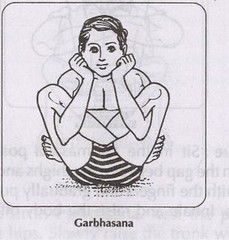
GARBHASANA – SITTING POSTURE
When this asana is performed, the pose achieved resembles that of a human foetus in the womb. So this asana is called Garbhasana.
Technique:
As a Kukkutasana, insert the hands between the thighs and the calves. Push the arms forward till the elbows can be easily bent. Then hold the lobe of the right ear with the right hand and of the left ear with the left hand. Stay in this position very cautiously to avoid tumbling. The constant practice of this asana will enable you to balance the body on the coccyx (the tail bone). If aspirants experience difficulty in performing this asana in Padmasana position, it should be practiced without Padmasana. While performing this asana, let the legs be stretched on the floor. The asana should be performed for 8 to 10 seconds in the beginning. Later, the time of the retention of the asana can be increased to one minute depending on age, ability of the aspirants and benefits expected.
Technique:
As a Kukkutasana, insert the hands between the thighs and the calves. Push the arms forward till the elbows can be easily bent. Then hold the lobe of the right ear with the right hand and of the left ear with the left hand. Stay in this position very cautiously to avoid tumbling. The constant practice of this asana will enable you to balance the body on the coccyx (the tail bone). If aspirants experience difficulty in performing this asana in Padmasana position, it should be practiced without Padmasana. While performing this asana, let the legs be stretched on the floor. The asana should be performed for 8 to 10 seconds in the beginning. Later, the time of the retention of the asana can be increased to one minute depending on age, ability of the aspirants and benefits expected.
UTTAMANGASANA
To practise Uttamangasana is not so easy as either Lolasana or kukkutasana. The body should be strong to practise this asana. Gymnasts can perform this asana very easily.
Technique : First sit in the position of padmsana. Then raise the knees and press them between the chest and the arms. Then raise the body with the force of the arms in such a way that the weight of the body falls on both the arms. While raising the body inhale and fill the lungs with air. Hold the breath. Exhale smoothly while coming to the original position. Gradually, incdrease the time for the practice of this asana. The limit is five minutes.
Advantages :
(1) This asana strengthens the joints and the muscles of the arms and the legs.
(2) As it eliminates the weakness of all the abdominal organs and the chest it is more important than Lolasana or kukkutasana.
(3) The regular practice of this asana roots out diseases like tuberculosis and asthma.
Technique : First sit in the position of padmsana. Then raise the knees and press them between the chest and the arms. Then raise the body with the force of the arms in such a way that the weight of the body falls on both the arms. While raising the body inhale and fill the lungs with air. Hold the breath. Exhale smoothly while coming to the original position. Gradually, incdrease the time for the practice of this asana. The limit is five minutes.
Advantages :
(1) This asana strengthens the joints and the muscles of the arms and the legs.
(2) As it eliminates the weakness of all the abdominal organs and the chest it is more important than Lolasana or kukkutasana.
(3) The regular practice of this asana roots out diseases like tuberculosis and asthma.
The Purification of The Body SHATKARMA Through Yoga
Prior to practising Yogasana,pranayama and meditation,it is desirable and also necessary to detoxify and purify the body.Toxic properties accumlate in the body for a number of reasons.If these toxins are not eliminated from the body,one would not get the desired benefits of Yogasana and Pranayama.
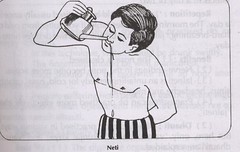
Neti :
There are various methods of doing 'neti' here,only Jalneti has been described.
For doing'Jalneti',a special kind of jug-'netilota'-is used.
Fill the jug with pure water.Add half a spoon of salt to it.First boil the water and then cool it.Stand in front of basin or in a mirror.Lower the head to the left side.Place the funnel of the jug into the right nostril.Further,lower the head slightly and raise the jug so that the water which entered the right nostril comes through the left nostril. Continue this 'Kriya' for a minute. Then take the funnel out of the right nostril.
Now place the funnel of the jug into the left nostril and lower the head to the right side so that the water which entered the left nostril may come out of the right nostril.Continue this'Kriya' for a minute.
Then sneeze fifteen to twenty times (breathing out forcefully from the nose) and let the water be evacuated from the nose.It is neccessary to make the nose dry.
Note:
(1) If the water comes into the mouth through the nostril,spit it,do not swallow it.
(2) There will be burning sensation in the nose and,with frequent sneezes,the eyes will fill with tears while doing 'Jalneti'. This is natural. You will be accustomed to these effects in a day or two.
Repetition:
'Jalneti' should be practised usually once in a day. The morning time is desirable. If you suffer from cold or hard-breathing,'Jalneti' may be practised two or three times a day.
Benefits:
(1) The nose is cleansed.
(2) Never-endings in the nose become more active.
(3) Jalneti is an unfailing remedy for cold,nasal catarrh,sinus,headache and migraine.
Neti :
There are various methods of doing 'neti' here,only Jalneti has been described.
For doing'Jalneti',a special kind of jug-'netilota'-is used.
Fill the jug with pure water.Add half a spoon of salt to it.First boil the water and then cool it.Stand in front of basin or in a mirror.Lower the head to the left side.Place the funnel of the jug into the right nostril.Further,lower the head slightly and raise the jug so that the water which entered the right nostril comes through the left nostril. Continue this 'Kriya' for a minute. Then take the funnel out of the right nostril.
Now place the funnel of the jug into the left nostril and lower the head to the right side so that the water which entered the left nostril may come out of the right nostril.Continue this'Kriya' for a minute.
Then sneeze fifteen to twenty times (breathing out forcefully from the nose) and let the water be evacuated from the nose.It is neccessary to make the nose dry.
Note:
(1) If the water comes into the mouth through the nostril,spit it,do not swallow it.
(2) There will be burning sensation in the nose and,with frequent sneezes,the eyes will fill with tears while doing 'Jalneti'. This is natural. You will be accustomed to these effects in a day or two.
Repetition:
'Jalneti' should be practised usually once in a day. The morning time is desirable. If you suffer from cold or hard-breathing,'Jalneti' may be practised two or three times a day.
Benefits:
(1) The nose is cleansed.
(2) Never-endings in the nose become more active.
(3) Jalneti is an unfailing remedy for cold,nasal catarrh,sinus,headache and migraine.
CHAKRASANA
In practicing this asana, the spine is twisted in such a way that the body forms a semicircular shape, hence this asana is called ‘Chakrasana’. It resembles a rainbow.Technique :
Lie flat on the back. Draw the legs in till the heels are close to the hips and the soles touch the ground. The gap between the legs should be of four to six inches. Bend the arms at the elbows and place them on the ground on either side of the head.
Raise the body from the waist to the hind part of the head as shown in the figures 2 and 3 breathe in the normal way. Tilt the head backwards as far as possible. Keep the hands straight. Keep the body steady. Do not shift either the arms or the legs from their positions. Raise the back as far as it allows it to do. (See figure 4). Remain in this position for about a minute. Then inhale and lower the body to the ground and bring it to the original position. Then breathe normally.
Advantages:
(1) Through this asana, an aspirant can make his spine quite elastic. Elasticity of the spine preserves youth for a very long time.
(2) This asana is an adjunct to Sarvangasana. When a long turn of Sarvangasana gives one a cramped neck or pain in the shoulders, a turn of Chakrasana helps to remove it. The reason is that the twist is on the backside.
(3)This asana has all the benefits of Dhanurasana, Shalabhasana and bhujangasana.
Labels:
chakrasana,
Yogasana
Sex and Yoga
Everybody's interested in sex. Whether it's to get pregnant, who's doing it and with whom, or how often is normal? We wonder what we should wear, or how much hair to remove to get more of it, or even how to market it? It's in our face in some way, often subliminally, and frequently in a distorted way every day. Men and women obviously have differing sexual needs, (not necessarily sex drives guys!), and this often leads to conflict. Conflict is the antithesis of yoga, yet within conflict there is always opportunity for unity. This is where yoga comes into play.
Sex and yoga is about harmony, about bringing balance into the equation so both sexes feel healthy, nourished and appreciated, free from all the usual repercussions or associated pressures. In my opinion the essence of sex is as a pathway to spiritual transformation and lasting physical well being. Basically yoga makes you feel good. It gets the blood pumping. It gets the hormones flushing through the body. It gives your skin a healthy youthful glow. It generates heat and stimulation from the inside out. It gives you energy, and that's sexy.
Sex and yoga are more intimately connected than we think. Sex feels good. Good sex with someone we love opens our hearts, makes us smile and relieves tension. Sex is about relationship, connection, intimacy, love and creative expression. At their best sex and yoga are about union, truth and love. To reveal those things in your life, your yoga practice, and your sex life takes a genuine commitment to creating a deeper sense of intimacy and overall wellbeing. In my journey as a yoga teacher I encourage all those things and created a yoga system as a way of putting it into a concise practice.
I use a unique system of corrective Japanese yoga postures, wholefood medicine and breath work, which has the potential to heal and enliven, stimulate and support both the sympathetic and parasympathetic nervous systems. When this happens, optimal function of our hormonal, lymphatic, circulatory, respiratory and digestive systems is restored. This makes us feel more vital, connected and present. We begin to engage more fully with life on all levels - mentally, emotionally, spiritually, physically and sexually.
To keep it simple: each section of our spine is governed by a particular meridian, and our very foundation, the sacrum, our base chakra into Mother Earth, dictates how secure, confident and trusting we feel within ourselves. Our sexual essence, that is, our base chakra or kundalini energy, is the connection between our Spirit and Universal Consciousness, or Love.
The flow of sexual hormones is governed primarily by our kidney energy and is intricately connected to our emotional health and how fluidly we move through life, and whether we speak our truth from our hearts and souls without fear. A strong aligned spine is the foundation channel for this universal energy so we can move through life, embrace challenges and grow into the full expression of ourselves.
Sex and yoga are therefore intricately entwined!
Our sexual and emotional confidence is governed by the quality of our Base chakra (perineum), Solar plexus chakra (navel) and Heart chakra. Yoga works to connect the potential in these chakras and energize the entire chakra system from the pelvic floor to our biggest sex organ, the brain. My female students have noticed marked improvement in their energy levels, regulation of, and reduced discomfort throughout their menstrual cycles, healthier hair and skin and a general sense of heightened vitality, libido and sexual responsiveness - all good things!
For women, the sequence will help correct gynaecological disorders, enhance fertility, counter osteoporosis, reduce varicose veins, rebuild pelvic floor integrity after childbirth (imperative on so many levels!), balance hormonal function and generally improve emotional and sexual confidence. My male students are honoured and nourished equally so they can start to access both their male and female energies (yin and yang) in an appropriate way to experience balance, intuition and emotional expression, rather than traditional repression.
They comment that they have become more empathetic with their partners and other men. They unravel learnt behaviours and stereotypes that stop them from feeling and being true to themselves, without losing their sense of masculinity. You can still be a bloke and sensitive. For men, the important issues of prostate health, virility/fertility, hair loss, libido, body confidence and stamina are addressed to help counter the effects of aging, modern day stresses and work and relationship pressures often placed upon them.
This ripples out into the greater community as energy of understanding, compassion, tolerance, self responsibility and positive response rather than reaction, and ultimately, respect for the opposite sex. These introductory postures take just 20 - 30 minutes a day and if possible should be done at least 3 times a week.
1: Gall Bladder Dips
Interlace hands behind head, R foot against L knee. Exhale and drop elbow to rear foot to open up opposite waist, draw elbows wide. Inhale to centre, repeat briskly x 8. Releases tight sides and brings softness to the shoulders & hips. Also releases the lines that govern the metabolism so we can maintain healthy weight and body image, plus tones the waist/hip line where we often store unresolved issues.
2: Spleen Bridge - Setu Bandha
Exhale and lift hips high, pressing through inside edge of feet. Inhale and lower one vertebra at a time to the mat. Repeat smoothly x 8, drawing knees in slightly to feel inner thigh line. Rest on back after and breathe - feel Spleen blood quality/pulsing up legs into belly. Upper body will soften and thoughts will relax as well as hormone flow improves. When we feel warm and nurtured from within this expresses as compassion and sensitivity towards ourselves and others. Spleen energy helps us make supportive choices & develops personal integrity so we don't repeat negative/destructive patterns in relation to ourselves or others.
3: Kidney/Spleen Lift
Lie on belly with L foot pressed into R inner knee, squeeze elbows into ribs. Exhale and lift hands and straight leg, pressing foot to knee and feeling the kidney area. Inhale and lower, repeat lifting x 6, then hold up and inhale. Exhale and squeeze around to L, lift chest and straight leg to draw awareness into weak points in lower back and increase blood flow and motivation into the kidneys. Inhale to centre, exhale and squeeze round to R. Swing L to R briskly x 10 then rest on belly with head to one side and breathe deeply.Stimulates endorphins and increases sexual vigor, builds libido and stamina.
4: Bow - Dhanurasana
Lie on belly and bend knees to hold ankles, forehead to mat. Exhale and lift into Bow, press belly into mat and resist feet with hands to open shoulders. Inhale and lower, rest briefly then repeat and hold up for 3-6 breaths. Relax and feel the lungs, heart and belly energies connecting. Excellent for reproductive organs, circulation and developing emotional sensitivity.
5: Downward Facing Dog - Adho Mukha Svanasana
Come onto all fours in Downward Dog (Adho Mukha Svanasana), hands shoulder width, feet hip width, bend knees if need too. Hold for 5 - 8 breaths, releasing the jaw and neck, lengthening the spine up to the tailbone and rolling the shoulders away from the ears. Downward Dog stretches the spine and nervous system channels to bring mental clarity, nourish the spine and nerves and counterpose to Dhanurasana. Downward Dog builds mental endurance, leg and arm strength and nourishes the endocrine system, strengthens the heart and builds overall health and organ function.
6: Triangle Pose - Trikonasana
Take legs one leg length apart, R foot heel dissects L arch, L toes turned in 30 degrees. Arms out to sides at shoulder height, spine long and legs engaged. Exhale and lean over R leg extending and lifting R arm to open R ribcage. Keep back foot grounded and belly drawn to spine. Lower R hand to shin and L fingers to ceiling in line with shoulder, look to floor or up along L fingertips. Hold and breathe 5 - 8 breaths, focusing on lengthening the spine, rotating the chest, extending the energy from the heart out into the fingertips and anchoring down into the legs. Come up to standing on an inhalation and switch feet to do the other side. Lay down on your back after for a few breaths to absorb the cleansing effect of the pose.
Trikonasana strengthens the legs, tones the abdominal organs, particularly the Liver, flushes the hormones and lymphatics and creates a sense of expansion, acceptance and patience. Clear Liver energy helps connect us with our inner wisdom and ability to see opportunities and make appropriate choices that support our direction and purpose in life.
7: Crocodile - Chaturanga
Lie on your belly, hands beside chest, toes tucked under and knees lifted off the mat so legs are elevated and parallel to the floor. Exhale and contract entire body to lift off the mat and squeeze from the belly out into the limbs. Keep elbows close to ribs, chest in line with elbows and elbows over the wrists. Hold up for 3 breaths then rest with head to one side.
Crocodile governs the lungs and helps develop breath capacity, mental stamina and a sense of empowerment. Strong lungs give us a sense of trust and positivity as we draw in nourishment and breathe out stagnancy. Healthy lungs fuel the blood with oxygen and regulate the nervous system which in turn makes us feel good and radiate vibrant, attractive energy.
8: Hara Bicycle
Lie on your back with legs long and hands interlaced behind the head. Exhale and draw R knee to chest, L elbow up and across to meet it. Feel the belly engage. Inhale to centre, exhale and swap sides. Briskly cycle to build your belly strength and tone your abdominal organs and harness inner strength. Hara bicycle connects the kidney and lung energies to circulate oxygen, adrenalin and promote production of fresh hormones. Hara (or belly centre) strength and integrity is essential to maintain optimal digestion and hormone balance. When we are disconnected from or congested in our bellies, we lose awareness of what is appropriate and inappropriate, on all levels.
9: Seated Butterfly - Baddhakonasana
Sit with soles together, knees wide and hands interlaced around edges of toes. Use hands against feet as traction to lift the chest and lengthen the spine. Close the eyes and focus on your breath at the end of your practice now, observing the shifts in your body and mind and getting a sense of the energies moving within. Baddhakonasana is an excellent hip opener that helps circulate fresh blood around the pelvis to nourish the reproductive organs. Sit quietly for 5 - 10 minutes, breathing in and out through the nose to calm the adrenals, drawing the breath down into the belly and sit bones so you feel grounded, nourished and calm. As always with any posture always move within a sharp-pain-free range of movement. If you feel uncomfortable with a posture just bring it back a little. Do remember though, you need to be fit for good sex so keep your practice going and enjoy Sex and Yoga.
Sex and yoga is about harmony, about bringing balance into the equation so both sexes feel healthy, nourished and appreciated, free from all the usual repercussions or associated pressures. In my opinion the essence of sex is as a pathway to spiritual transformation and lasting physical well being. Basically yoga makes you feel good. It gets the blood pumping. It gets the hormones flushing through the body. It gives your skin a healthy youthful glow. It generates heat and stimulation from the inside out. It gives you energy, and that's sexy.
Sex and yoga are more intimately connected than we think. Sex feels good. Good sex with someone we love opens our hearts, makes us smile and relieves tension. Sex is about relationship, connection, intimacy, love and creative expression. At their best sex and yoga are about union, truth and love. To reveal those things in your life, your yoga practice, and your sex life takes a genuine commitment to creating a deeper sense of intimacy and overall wellbeing. In my journey as a yoga teacher I encourage all those things and created a yoga system as a way of putting it into a concise practice.
I use a unique system of corrective Japanese yoga postures, wholefood medicine and breath work, which has the potential to heal and enliven, stimulate and support both the sympathetic and parasympathetic nervous systems. When this happens, optimal function of our hormonal, lymphatic, circulatory, respiratory and digestive systems is restored. This makes us feel more vital, connected and present. We begin to engage more fully with life on all levels - mentally, emotionally, spiritually, physically and sexually.
To keep it simple: each section of our spine is governed by a particular meridian, and our very foundation, the sacrum, our base chakra into Mother Earth, dictates how secure, confident and trusting we feel within ourselves. Our sexual essence, that is, our base chakra or kundalini energy, is the connection between our Spirit and Universal Consciousness, or Love.
The flow of sexual hormones is governed primarily by our kidney energy and is intricately connected to our emotional health and how fluidly we move through life, and whether we speak our truth from our hearts and souls without fear. A strong aligned spine is the foundation channel for this universal energy so we can move through life, embrace challenges and grow into the full expression of ourselves.
Sex and yoga are therefore intricately entwined!
Our sexual and emotional confidence is governed by the quality of our Base chakra (perineum), Solar plexus chakra (navel) and Heart chakra. Yoga works to connect the potential in these chakras and energize the entire chakra system from the pelvic floor to our biggest sex organ, the brain. My female students have noticed marked improvement in their energy levels, regulation of, and reduced discomfort throughout their menstrual cycles, healthier hair and skin and a general sense of heightened vitality, libido and sexual responsiveness - all good things!
For women, the sequence will help correct gynaecological disorders, enhance fertility, counter osteoporosis, reduce varicose veins, rebuild pelvic floor integrity after childbirth (imperative on so many levels!), balance hormonal function and generally improve emotional and sexual confidence. My male students are honoured and nourished equally so they can start to access both their male and female energies (yin and yang) in an appropriate way to experience balance, intuition and emotional expression, rather than traditional repression.
They comment that they have become more empathetic with their partners and other men. They unravel learnt behaviours and stereotypes that stop them from feeling and being true to themselves, without losing their sense of masculinity. You can still be a bloke and sensitive. For men, the important issues of prostate health, virility/fertility, hair loss, libido, body confidence and stamina are addressed to help counter the effects of aging, modern day stresses and work and relationship pressures often placed upon them.
This ripples out into the greater community as energy of understanding, compassion, tolerance, self responsibility and positive response rather than reaction, and ultimately, respect for the opposite sex. These introductory postures take just 20 - 30 minutes a day and if possible should be done at least 3 times a week.
1: Gall Bladder Dips
Interlace hands behind head, R foot against L knee. Exhale and drop elbow to rear foot to open up opposite waist, draw elbows wide. Inhale to centre, repeat briskly x 8. Releases tight sides and brings softness to the shoulders & hips. Also releases the lines that govern the metabolism so we can maintain healthy weight and body image, plus tones the waist/hip line where we often store unresolved issues.
2: Spleen Bridge - Setu Bandha
Exhale and lift hips high, pressing through inside edge of feet. Inhale and lower one vertebra at a time to the mat. Repeat smoothly x 8, drawing knees in slightly to feel inner thigh line. Rest on back after and breathe - feel Spleen blood quality/pulsing up legs into belly. Upper body will soften and thoughts will relax as well as hormone flow improves. When we feel warm and nurtured from within this expresses as compassion and sensitivity towards ourselves and others. Spleen energy helps us make supportive choices & develops personal integrity so we don't repeat negative/destructive patterns in relation to ourselves or others.
3: Kidney/Spleen Lift
Lie on belly with L foot pressed into R inner knee, squeeze elbows into ribs. Exhale and lift hands and straight leg, pressing foot to knee and feeling the kidney area. Inhale and lower, repeat lifting x 6, then hold up and inhale. Exhale and squeeze around to L, lift chest and straight leg to draw awareness into weak points in lower back and increase blood flow and motivation into the kidneys. Inhale to centre, exhale and squeeze round to R. Swing L to R briskly x 10 then rest on belly with head to one side and breathe deeply.Stimulates endorphins and increases sexual vigor, builds libido and stamina.
4: Bow - Dhanurasana
Lie on belly and bend knees to hold ankles, forehead to mat. Exhale and lift into Bow, press belly into mat and resist feet with hands to open shoulders. Inhale and lower, rest briefly then repeat and hold up for 3-6 breaths. Relax and feel the lungs, heart and belly energies connecting. Excellent for reproductive organs, circulation and developing emotional sensitivity.
5: Downward Facing Dog - Adho Mukha Svanasana
Come onto all fours in Downward Dog (Adho Mukha Svanasana), hands shoulder width, feet hip width, bend knees if need too. Hold for 5 - 8 breaths, releasing the jaw and neck, lengthening the spine up to the tailbone and rolling the shoulders away from the ears. Downward Dog stretches the spine and nervous system channels to bring mental clarity, nourish the spine and nerves and counterpose to Dhanurasana. Downward Dog builds mental endurance, leg and arm strength and nourishes the endocrine system, strengthens the heart and builds overall health and organ function.
6: Triangle Pose - Trikonasana
Take legs one leg length apart, R foot heel dissects L arch, L toes turned in 30 degrees. Arms out to sides at shoulder height, spine long and legs engaged. Exhale and lean over R leg extending and lifting R arm to open R ribcage. Keep back foot grounded and belly drawn to spine. Lower R hand to shin and L fingers to ceiling in line with shoulder, look to floor or up along L fingertips. Hold and breathe 5 - 8 breaths, focusing on lengthening the spine, rotating the chest, extending the energy from the heart out into the fingertips and anchoring down into the legs. Come up to standing on an inhalation and switch feet to do the other side. Lay down on your back after for a few breaths to absorb the cleansing effect of the pose.
Trikonasana strengthens the legs, tones the abdominal organs, particularly the Liver, flushes the hormones and lymphatics and creates a sense of expansion, acceptance and patience. Clear Liver energy helps connect us with our inner wisdom and ability to see opportunities and make appropriate choices that support our direction and purpose in life.
7: Crocodile - Chaturanga
Lie on your belly, hands beside chest, toes tucked under and knees lifted off the mat so legs are elevated and parallel to the floor. Exhale and contract entire body to lift off the mat and squeeze from the belly out into the limbs. Keep elbows close to ribs, chest in line with elbows and elbows over the wrists. Hold up for 3 breaths then rest with head to one side.
Crocodile governs the lungs and helps develop breath capacity, mental stamina and a sense of empowerment. Strong lungs give us a sense of trust and positivity as we draw in nourishment and breathe out stagnancy. Healthy lungs fuel the blood with oxygen and regulate the nervous system which in turn makes us feel good and radiate vibrant, attractive energy.
8: Hara Bicycle
Lie on your back with legs long and hands interlaced behind the head. Exhale and draw R knee to chest, L elbow up and across to meet it. Feel the belly engage. Inhale to centre, exhale and swap sides. Briskly cycle to build your belly strength and tone your abdominal organs and harness inner strength. Hara bicycle connects the kidney and lung energies to circulate oxygen, adrenalin and promote production of fresh hormones. Hara (or belly centre) strength and integrity is essential to maintain optimal digestion and hormone balance. When we are disconnected from or congested in our bellies, we lose awareness of what is appropriate and inappropriate, on all levels.
9: Seated Butterfly - Baddhakonasana
Sit with soles together, knees wide and hands interlaced around edges of toes. Use hands against feet as traction to lift the chest and lengthen the spine. Close the eyes and focus on your breath at the end of your practice now, observing the shifts in your body and mind and getting a sense of the energies moving within. Baddhakonasana is an excellent hip opener that helps circulate fresh blood around the pelvis to nourish the reproductive organs. Sit quietly for 5 - 10 minutes, breathing in and out through the nose to calm the adrenals, drawing the breath down into the belly and sit bones so you feel grounded, nourished and calm. As always with any posture always move within a sharp-pain-free range of movement. If you feel uncomfortable with a posture just bring it back a little. Do remember though, you need to be fit for good sex so keep your practice going and enjoy Sex and Yoga.
Benefits Of Yoga Balancing
Most of us suffer from problems of asymmetry and imbalance. The irregularity and imbalance create a lot of stress and strain in our body. At times, it also leads to injury, pain, or just simple discomfort. If you are also one amongst the sufferers, do not worry. Just turn to Yoga. Yoga creates symmetry throughout your body, making you stronger, flexible and balanced. It also draws a balance between the mental urge to push, control and be assertive, with the impulse to yield, submit and be passive. Practicing the various asans, concentrating and meditation improves the overall being of an individual.
Benefits Of Yoga:
Improvement in balance is one of the major benefits of Yoga. Improved balance is referred not only to the sharp physical coordination, but also to the balance between the left and right, front and back and high and low aspects of one's body. As far as balance of the body is concerned, hardly few of us have proper balance. We may be stronger on one side, but definitely fall short of strength when it comes to the other side. The same is also seen, while turning or twisting the head. Whilst we can easily twist or turn on one side, the other is always a problem. Also, though most of can bend forward with ease, bending backwards is a big problem.
Yoga helps us attain hormonal balance, by producing a nice positive charge. This is important from the female point of view, especially for pre-menopausal and menopausal women, who want to find ways to balance their hormones naturally. To attain good balance, you need not be physically strong, but also have the mental agility to focus on your posture. There are a number of asanas that aim at achieving balance in the body. One of them is 'Tadasana' or mountain pose, which requires you to stand straight with your legs slightly apart and eyes closed. It would help you realize, which side of your body is more powerful and where do you tend to concentrate your weight on.
After performing 'Tadasana', you can perform the one-legged stand. This is generally done to achieve center balance. The longer the duration of the pose, the better are the chances of improving balance. Another effective asan is the 'Vrksasana' or tree pose. It strengthens the leg and calf muscles, making it easier to balance the body. 'Matsyasana' or fish pose asan is also beneficial for postural alignment. In this particular asan, you lie down on your back forming an arching. This helps in the curvature of your spine, making it more flexible and longer.
However, before performing any of the asan mentioned above, you should learn the proper techniques from a trained instructor. Remember, proper Yoga practice ensures not only physical balance, but also emotional and spiritual balance.
Benefits Of Yoga:
Improvement in balance is one of the major benefits of Yoga. Improved balance is referred not only to the sharp physical coordination, but also to the balance between the left and right, front and back and high and low aspects of one's body. As far as balance of the body is concerned, hardly few of us have proper balance. We may be stronger on one side, but definitely fall short of strength when it comes to the other side. The same is also seen, while turning or twisting the head. Whilst we can easily twist or turn on one side, the other is always a problem. Also, though most of can bend forward with ease, bending backwards is a big problem.
Yoga helps us attain hormonal balance, by producing a nice positive charge. This is important from the female point of view, especially for pre-menopausal and menopausal women, who want to find ways to balance their hormones naturally. To attain good balance, you need not be physically strong, but also have the mental agility to focus on your posture. There are a number of asanas that aim at achieving balance in the body. One of them is 'Tadasana' or mountain pose, which requires you to stand straight with your legs slightly apart and eyes closed. It would help you realize, which side of your body is more powerful and where do you tend to concentrate your weight on.
After performing 'Tadasana', you can perform the one-legged stand. This is generally done to achieve center balance. The longer the duration of the pose, the better are the chances of improving balance. Another effective asan is the 'Vrksasana' or tree pose. It strengthens the leg and calf muscles, making it easier to balance the body. 'Matsyasana' or fish pose asan is also beneficial for postural alignment. In this particular asan, you lie down on your back forming an arching. This helps in the curvature of your spine, making it more flexible and longer.
However, before performing any of the asan mentioned above, you should learn the proper techniques from a trained instructor. Remember, proper Yoga practice ensures not only physical balance, but also emotional and spiritual balance.
Help Cure or Prevent Backaches with Yoga
For many centuries, people have used yoga for a number of different reasons. Whilst in the beginning yoga was mainly used for spiritual reasons, in more recent years, it has started to be used for therapeutic purposes. For instance, people with back troubles will generally search for some form of exercise that will assist them with their condition. Yoga tends to be a beneficial exercise for relief of many forms of pain for a number of reasons. Can yoga help to relieve your back pain? Potentially yes, and here are a few reasons as to why it could help you.
One of the main benefits of yoga is that it allows your body to become more supple. There are several different stretching exercises that are involved in yoga and these exercises are able to help your back in an astounding way. Naturally, you need to be careful that you don’t over do things, especially dependant upon the type of back injury/pain that you are experiencing. For the majority of people, however, a small amount of yoga can really assist you with being more comfortable and perhaps even help to overcome the back pain that you are experiencing altogether. As well as helping to relieve back pain, yoga can also aid you with a number of other benefits, from performing these types of stretching exercises.
One such way that yoga can help, is by reaching the core of the problem. One of the reasons that many people suffer from backache, is because the core of their body is either out of shape or out of alignment. This could be due to either a lack of exercise or perhaps from being slightly overweight.
It might also be a combination of issues that can be resonating from the core of the body. Yoga exercises are designed to help strengthen the core, which can really benefit the back. You may have heard it said that in order for you to strengthen your back, you need to strengthen your abdominal muscles.This is basically the same principle.
One final way that yoga may assist you with backaches is by helping to prevent the pain from reoccurring again. This is achieved through both the stretching exercises and by strengthening the core muscles. By continuing and practising these stretching exercises, you will soon discover that you are able to do things that you were unable to do before. You will find that it’s a great relief to be able to go about your day to day life without having to worry as much about throwing your back out.
One of the main benefits of yoga is that it allows your body to become more supple. There are several different stretching exercises that are involved in yoga and these exercises are able to help your back in an astounding way. Naturally, you need to be careful that you don’t over do things, especially dependant upon the type of back injury/pain that you are experiencing. For the majority of people, however, a small amount of yoga can really assist you with being more comfortable and perhaps even help to overcome the back pain that you are experiencing altogether. As well as helping to relieve back pain, yoga can also aid you with a number of other benefits, from performing these types of stretching exercises.
One such way that yoga can help, is by reaching the core of the problem. One of the reasons that many people suffer from backache, is because the core of their body is either out of shape or out of alignment. This could be due to either a lack of exercise or perhaps from being slightly overweight.
It might also be a combination of issues that can be resonating from the core of the body. Yoga exercises are designed to help strengthen the core, which can really benefit the back. You may have heard it said that in order for you to strengthen your back, you need to strengthen your abdominal muscles.This is basically the same principle.
One final way that yoga may assist you with backaches is by helping to prevent the pain from reoccurring again. This is achieved through both the stretching exercises and by strengthening the core muscles. By continuing and practising these stretching exercises, you will soon discover that you are able to do things that you were unable to do before. You will find that it’s a great relief to be able to go about your day to day life without having to worry as much about throwing your back out.
PADAHASTASANA
If 'Pashchimottanasana' is attained in a standing posture, it becomes a different Yogic exercise known as 'Padahastasana'. This asana is also called 'Sthita Pashchi mottanasana'. Some people call it 'Hastapada Mangasana'.
Technique :
Stand erect. Keep the arms by the sides. Keep the heels close together. Keep some gap between the feet. Raise both the arms. Slowly bend forward at the waist. Keep the knees stiff and firm. The legs should not bend at the knees. Also do not let the arms bend at the elbows. Keep the palms under the feet as shown in the figure. Slowly exhale while bending low and contract the stomach. Now put your forehead between the knees. If it is difficult to bend low because of fat around the abdomen, try to bend the body slowly; do not bend the knees. Hold this position for two to ten seconds.
Advantages :
(1) This asana removes the superfluous fat from the body making the body light.
(2) It has all the benefits of Pashchimottanasana.
(3) It directs the 'apanvayu' downwards and out at the anus.
(4)It rectifies any unevenness in length in the leg owing to the fracture of any bones either in the leg or the thigh.
Technique :
Stand erect. Keep the arms by the sides. Keep the heels close together. Keep some gap between the feet. Raise both the arms. Slowly bend forward at the waist. Keep the knees stiff and firm. The legs should not bend at the knees. Also do not let the arms bend at the elbows. Keep the palms under the feet as shown in the figure. Slowly exhale while bending low and contract the stomach. Now put your forehead between the knees. If it is difficult to bend low because of fat around the abdomen, try to bend the body slowly; do not bend the knees. Hold this position for two to ten seconds.
Advantages :
(1) This asana removes the superfluous fat from the body making the body light.
(2) It has all the benefits of Pashchimottanasana.
(3) It directs the 'apanvayu' downwards and out at the anus.
(4)It rectifies any unevenness in length in the leg owing to the fracture of any bones either in the leg or the thigh.
Labels:
Padahastasana,
Yogasana
TRIKONASANA
When the final position is struck in this Yogic exercise, the body of the performer resembles a triangle, hence the name Trikonasana. The figures of its four positions have been given below to explain the right technique of this asana.
Technique :
Stand erect keeping a distance of about 75 cms between the feet. Stretch the arms sideways. Then raise them to the level of the shoulders. Let the palms face the ground. Stand erect.
(See figure 1).
Then bend the trunk to the left side and touch the left toes with the left hand. Stretch the right arm upwards and straighten it. Keep the eyes fixed on the right arm. Bring the left hand near the left toe.
(See figure 2).
Keep the left hand in the same position and rotate the right arm from over the waist and bring it to the head level. Look downward.
(See figure 3).
Then touch the right toes with the right hand. This is the final position of Trikonasana.
(See figure 4).
Rest for five to ten seconds and repeat this exercise with the right arm upside and the left arm upside. Hold each position for two seconds. Practice this asana four or five times a day.
Advantages :
(1) This asana relieves the stiffness of the neck.
(2) It relieves the pain in the joints of the neck and the shoulders. It also exercises the spinal cord, the hips, the thighs, the arms and the fingers.
(3) It makes the spine flexible and develops the mental power. This asana is also beneficial to the eyes.
Technique :
Stand erect keeping a distance of about 75 cms between the feet. Stretch the arms sideways. Then raise them to the level of the shoulders. Let the palms face the ground. Stand erect.
(See figure 1).
Then bend the trunk to the left side and touch the left toes with the left hand. Stretch the right arm upwards and straighten it. Keep the eyes fixed on the right arm. Bring the left hand near the left toe.
(See figure 2).
Keep the left hand in the same position and rotate the right arm from over the waist and bring it to the head level. Look downward.
(See figure 3).
Then touch the right toes with the right hand. This is the final position of Trikonasana.
(See figure 4).
Rest for five to ten seconds and repeat this exercise with the right arm upside and the left arm upside. Hold each position for two seconds. Practice this asana four or five times a day.
Advantages :
(1) This asana relieves the stiffness of the neck.
(2) It relieves the pain in the joints of the neck and the shoulders. It also exercises the spinal cord, the hips, the thighs, the arms and the fingers.
(3) It makes the spine flexible and develops the mental power. This asana is also beneficial to the eyes.
Labels:
Trikonasana,
Yogasana
Most Americans Think It's Others Who Are Unhealthy
Despite rising rates of obesity and diabetes, a new survey has found that a majority of Americans believe their health is just fine - it's everyone else who has the problem.
More than 50 percent of respondents said that other people's health "was going in the wrong direction." In contrast, only 17 percent said their own health was going in the wrong direction.
Commissioned by GE Healthcare, The Cleveland Clinic and Ochsner Health System, the survey looked at how Americans and their health-care professionals rate the country's health. The findings, which were released Tuesday, show a big disconnect between how Americans rate their own personal health and how they rate the health of their fellow Americans. Furthermore, Americans seem to think they are in much better shape than their doctors believe they are.
"Either people are denying reality about themselves or they don't have the correct knowledge and believe they are doing the right things," said study author Dr. Michael Roizen, chairman of The Cleveland Clinic's Wellness Institute. "Personally, I think there is a lot of misinformation [about healthy habits]."
On the other hand, Roizen added, many physicians may be overstating their concern about the health of the general population because they tend to see the sickest.
According to the study, which surveyed more than 2,000 people across the United States late last year:
1. Nearly 30 percent of the respondents gave themselves an A for managing their personal health, while 92 percent of doctors gave them a C or lower.
2. Nearly a third of the study respondents gave themselves an A for eating healthy. Once again, 92 percent of doctors gave them a C or lower.
3. About a third gave themselves an A for getting regular exercise, while 91 percent of physicians gave them a C or lower.
One disconnect is that in a land where a majority of people are overweight or obese, people tend to compare themselves favorably with their more overweight neighbors, explained Eva To, a registered dietician in White Plains, N.Y.
"Everything is relative," she said. "In America, everything is big. But if you put them in an Asian country, they will compare themselves to someone else."
Another problem seems to be that many respondents didn't know their basic health numbers - blood pressure, cholesterol, glucose level and other measures. Just 24 percent knew their body-mass index; 29 percent knew their blood glucose level; 33 percent knew their daily caloric intake; and only 36 percent knew their current cholesterol levels.
And yet a majority reported that keeping those numbers in a good range was key to good health. Ninety-five percent agreed that regular checkups with their physicians were important, even though 70 percent said they had taken actions to avoid their doctors, such as hoping their health problems would go away on their own or asking a friend for medical advice instead.
"It is important that patients communicate with their personal physicians to help manage their own health," said Dr. Scott Hayworth, president and CEO of Mount Kisco Medical Group in New York. "With this comes an obligation to be aware of how well they are following guidelines for exercise, diet and weight management."
It's a task that may be easier said than done, according to To.
"Americans are just not into prevention," she said. "If they are not sick, they think they are healthy. But most of the killers are silent diseases, such as diabetes, high blood pressure and hardening of the arteries. We don't feel it, but they are killers all the same."
People also tend to rationalize their bad behavior by believing that the good things they do cancel out the negative. An extra slice of pizza, for example, may be justified as OK after a workout.
"People may say they eat salad for lunch, but what about the salad dressing?" said To. "They look at one element and not look at the whole picture."
More than 50 percent of respondents said that other people's health "was going in the wrong direction." In contrast, only 17 percent said their own health was going in the wrong direction.
Commissioned by GE Healthcare, The Cleveland Clinic and Ochsner Health System, the survey looked at how Americans and their health-care professionals rate the country's health. The findings, which were released Tuesday, show a big disconnect between how Americans rate their own personal health and how they rate the health of their fellow Americans. Furthermore, Americans seem to think they are in much better shape than their doctors believe they are.
"Either people are denying reality about themselves or they don't have the correct knowledge and believe they are doing the right things," said study author Dr. Michael Roizen, chairman of The Cleveland Clinic's Wellness Institute. "Personally, I think there is a lot of misinformation [about healthy habits]."
On the other hand, Roizen added, many physicians may be overstating their concern about the health of the general population because they tend to see the sickest.
According to the study, which surveyed more than 2,000 people across the United States late last year:
1. Nearly 30 percent of the respondents gave themselves an A for managing their personal health, while 92 percent of doctors gave them a C or lower.
2. Nearly a third of the study respondents gave themselves an A for eating healthy. Once again, 92 percent of doctors gave them a C or lower.
3. About a third gave themselves an A for getting regular exercise, while 91 percent of physicians gave them a C or lower.
One disconnect is that in a land where a majority of people are overweight or obese, people tend to compare themselves favorably with their more overweight neighbors, explained Eva To, a registered dietician in White Plains, N.Y.
"Everything is relative," she said. "In America, everything is big. But if you put them in an Asian country, they will compare themselves to someone else."
Another problem seems to be that many respondents didn't know their basic health numbers - blood pressure, cholesterol, glucose level and other measures. Just 24 percent knew their body-mass index; 29 percent knew their blood glucose level; 33 percent knew their daily caloric intake; and only 36 percent knew their current cholesterol levels.
And yet a majority reported that keeping those numbers in a good range was key to good health. Ninety-five percent agreed that regular checkups with their physicians were important, even though 70 percent said they had taken actions to avoid their doctors, such as hoping their health problems would go away on their own or asking a friend for medical advice instead.
"It is important that patients communicate with their personal physicians to help manage their own health," said Dr. Scott Hayworth, president and CEO of Mount Kisco Medical Group in New York. "With this comes an obligation to be aware of how well they are following guidelines for exercise, diet and weight management."
It's a task that may be easier said than done, according to To.
"Americans are just not into prevention," she said. "If they are not sick, they think they are healthy. But most of the killers are silent diseases, such as diabetes, high blood pressure and hardening of the arteries. We don't feel it, but they are killers all the same."
People also tend to rationalize their bad behavior by believing that the good things they do cancel out the negative. An extra slice of pizza, for example, may be justified as OK after a workout.
"People may say they eat salad for lunch, but what about the salad dressing?" said To. "They look at one element and not look at the whole picture."
Labels:
Health
Hatha Yoga Practice Lessens Fear Of Falling In Older Adults, Study Suggests
Indiana University researchers found promising results in an exploratory study involving yoga practice by older adults who expressed a fear of falling. After a 12-week, twice weekly hatha yoga class, taught by a professional yoga therapist, study participants reported a reduced fear of falling, increased lower body flexibility and a reduction in their leisure constraints.
Fear of falling is an important public health concern because it can cause older adults -- even those who have not fallen -- to limit their social and physical activity. This effort to avoid falls can create a harmful cycle that can diminish health and quality of life.
"Our study found that yoga was a feasible intervention with older adults and that they perceived great benefit from it," said Marieke Van Puymbroeck, assistant professor in the Department of Recreation, Park and Tourism Studies in IU's School of Health, Physical Education and Recreation.
Van Puymbroeck discussed some of her findings this month at the International Association of Yoga Therapists' Symposium for Yoga Therapy and Research in Los Angeles and will discuss her findings further at conferences hosted by the American Geriatrics Society and the American Therapeutic Recreation Association. More about the study:
The study involved 14 men and women with an average age of 78. Five participants had fallen previously.
1. Van Puymbroeck said the 90 percent weekly attendance rate was notable, as was the 6 percent dropout rate, which she said was much lower than most physical activity and yoga studies. The participants took a class in hatha yoga, which is a gentle form of yoga that easily can be adapted for individual needs and can be performed from a seated position. The twice weekly classes each lasted 60 minutes.
2. After the 12-week class, participants reported a 6 percent reduction in their fear of falling, a 34 percent increase in lower body flexibility, and a statistically significant reduction in leisure constraints.
3. Van Puymbroeck said participants reported "tremendous benefits," with emerging themes that included the ability to generalize principals of posture to other situations, increased range of motion, increased flexibility and improved balance.
Co-investigators include David Koceja, Department of Kinesiology in IU Bloomington's School of HPER; and Arlene Schmid, Department of Occupational Therapy and Department of Veterans Affairs, Indiana University-Purdue University Indianapolis.
Fear of falling is an important public health concern because it can cause older adults -- even those who have not fallen -- to limit their social and physical activity. This effort to avoid falls can create a harmful cycle that can diminish health and quality of life.
"Our study found that yoga was a feasible intervention with older adults and that they perceived great benefit from it," said Marieke Van Puymbroeck, assistant professor in the Department of Recreation, Park and Tourism Studies in IU's School of Health, Physical Education and Recreation.
Van Puymbroeck discussed some of her findings this month at the International Association of Yoga Therapists' Symposium for Yoga Therapy and Research in Los Angeles and will discuss her findings further at conferences hosted by the American Geriatrics Society and the American Therapeutic Recreation Association. More about the study:
The study involved 14 men and women with an average age of 78. Five participants had fallen previously.
1. Van Puymbroeck said the 90 percent weekly attendance rate was notable, as was the 6 percent dropout rate, which she said was much lower than most physical activity and yoga studies. The participants took a class in hatha yoga, which is a gentle form of yoga that easily can be adapted for individual needs and can be performed from a seated position. The twice weekly classes each lasted 60 minutes.
2. After the 12-week class, participants reported a 6 percent reduction in their fear of falling, a 34 percent increase in lower body flexibility, and a statistically significant reduction in leisure constraints.
3. Van Puymbroeck said participants reported "tremendous benefits," with emerging themes that included the ability to generalize principals of posture to other situations, increased range of motion, increased flexibility and improved balance.
Co-investigators include David Koceja, Department of Kinesiology in IU Bloomington's School of HPER; and Arlene Schmid, Department of Occupational Therapy and Department of Veterans Affairs, Indiana University-Purdue University Indianapolis.
Labels:
Hatha Yoga,
Yogasana
Kapalbhati Pranayama (Cleansing Breathing Exercise) Step by Step and Shining Face

What we do in Kapalbhati Pranayama
In Kapalabhati we do quick exhalation and natural inhalation. Normally exhalation takes one fourth of the time of inhalation. Quick exhalation and natural inhalation follow each other.
How to do Kapalbhati Pranayama
Step 1) Sit in comfortable crossed leg position with Back straight. Hands resting on knees in either chin or gyana mudra. Face to be relaxed.Step 2) Inhale deeply through both nostril, expanding abdomen and exhale with the forceful contraction of abdominal muscles. (Pull the abdomen in by quickly contracting the abdominal muscles and exhale through the nose). The air is pushed out of lungs by contraction of the diaphragm.
Step 3) After exhalation again inhalation but inhalation should not involve any effort. To inhale just relax and the lungs will automatically expand and filled with air.
One can begin with 15 respiration. After completing 15 quick exhalation and natural inhalation , inhale and exhale deeply. This is one round.One can start the practice of Kapalbhati pranayama with 3 such rounds for practice.
Benefits of Kapalabhati
1) Kapalabhati cleanses the lungs and entire respiratory system.2) The blood is purified and body gets an increased supply of oxygen to all cells.
3) Digestion is improved.
4) Abdominal muscles are strengthened.
5) Prepare the mind for meditation.
6) Energise the mind for mental work.
Precautions:
Kapalbhati should not be practice by those
a) Suffering from heart disease
b) High blood pressure
c) Hernia
d) Should never be practiced when an asthmatic attack is in progress.
e) If pain or dizziness is experienced ,it is preferable to stop the practice till the sensation has passed. Practiced can be restarted with less force.
f) Quick exhalation should be comfortable to oneself. i.e. quick exhalation should not be too forceful.
Common Mistake:
1) Abdomen is contracted while inhaling.
2) Shoulders are contracted to push the air out when exhaling.
3) Back and shoulders move during exercise.
Point to Note:
a) Exercise should not be done if you are feeling uncomfortable at any time during the exercise.
b) Rapid breathing used in this technique should be from the abdomen and not from the chest.
c) Kapalbhati should be practice on an empty stomach only.
d) Kapalbhati should be practiced after the asanas and Relaxation (atleast 10 minutes) and before meditation e) Chest should not move very much.
f) It is always good and advisable that this exercise should be learned under supervision of yoga teacher after discussion with him about your health
Yoga Breathing Techniques - 5 Ujjayi Pranayama Steps For Curing Insomnia
If there's one medical condition which can seemingly strike anyone at anytime, that is none other than insomnia. This common sleep disorder can have psychological, physiological, environmental and medical reasons. Now, if you are one of the millions of people who are suffering from this condition, did you know that there is a type of yoga which can help cure it?
The key is to learn about the breathing techniques involved in the Ujjayi Pranayama - a style of yoga which is also called ocean breath, hissing breath and victorious breath. Ujjayi literally means rising victoriously. When you practice this style, you can use the techniques to cure any sleeping disorders that you may have.
1) Begin the yogic breathing technique by taking five long, deep and slow breaths. This should help in the relaxation phase.
2) If you are using the Ujjayi Pranayama steps to specifically cure insomnia, close your eyes during the exercise.
3) Next, try to constrict your throat muscles. At this point, it would help if you will visualize that you are breathing through a hold in your throat. This type of yogic exercise is also known as 'ocean breath' because of the sound that will be made by the air passing through your throat. The point of this step in the exercise is to breathe through your throat instead of through your nose.
4) Find a nice, slow and relaxing rhythm as you continue with this style. Imagine that you are in a peaceful, calm beach with only the sound of the surf as your companion.
5) Continue with this exercise until you relax completely and fall asleep eventually.
As you can see, the steps involved in this breathing exercise are quite easy. The good thing about using the Ujjayi Pranayama techniques is that it will produce health benefits like lowering your blood pressure and ultimately relaxing you once you go to bed and try to sleep. As your body regains its equilibrium, your mind will also calm down and you can emerge successful in the fight against the sleeping disorder which is insomnia.
The key is to learn about the breathing techniques involved in the Ujjayi Pranayama - a style of yoga which is also called ocean breath, hissing breath and victorious breath. Ujjayi literally means rising victoriously. When you practice this style, you can use the techniques to cure any sleeping disorders that you may have.
5 Steps to Develop a Breathing Technique
To help you out, here are the five steps that you need to follow if you want to develop a technique based from Ujjayi Pranayama yoga - which should help cure you of insomnia:1) Begin the yogic breathing technique by taking five long, deep and slow breaths. This should help in the relaxation phase.
2) If you are using the Ujjayi Pranayama steps to specifically cure insomnia, close your eyes during the exercise.
3) Next, try to constrict your throat muscles. At this point, it would help if you will visualize that you are breathing through a hold in your throat. This type of yogic exercise is also known as 'ocean breath' because of the sound that will be made by the air passing through your throat. The point of this step in the exercise is to breathe through your throat instead of through your nose.
4) Find a nice, slow and relaxing rhythm as you continue with this style. Imagine that you are in a peaceful, calm beach with only the sound of the surf as your companion.
5) Continue with this exercise until you relax completely and fall asleep eventually.
As you can see, the steps involved in this breathing exercise are quite easy. The good thing about using the Ujjayi Pranayama techniques is that it will produce health benefits like lowering your blood pressure and ultimately relaxing you once you go to bed and try to sleep. As your body regains its equilibrium, your mind will also calm down and you can emerge successful in the fight against the sleeping disorder which is insomnia.
Yoga And Sex: A Guide To A Better Life
The Yogis have learned how to transmute sex energy into psychic channels. Thus it is never either actually suppressed or dissipated but rather transmuted. Sometimes it is drawn to the solar plexus for utilizing in healthful physical exercise.
Sometimes it is sent to the brain and toward the spirit. To the advanced Yogi, yoga and sex then brings poise, harmony, freedom from desire, lasting serenity, and finally a merging with the Universal Consciousness. To us average individuals, control over this basic inner force may well mean a happier personal life.
The man and woman doesn't exist whose personal life is not closely related to his sex life, be this good, indifferent or bad. The well-adjusted, well-functioning and sexually potent individual dreams of perpetuating this state of affairs indefinitely. The ineffectual man, the frigid woman, even if they may not realize it themselves, wish helplessly for a solution to their special problems, a solution that would bring them liberation.
Yoga offers many such solutions. In the first place, a number of the yoga exercises help sublimate a restless sex urge while others awaken a sluggish body. Restlessness becomes positive, creative energy which may then be properly utilized instead of merely bringing trouble.
Conversely, lack of interest in one's mate - and sometimes the free-floating hostility arising out of such feelings - slowly gives way to a warmer, more giving attitude.
Sex, as we all know, is not all there is to a good marriage but it is one of its cornerstones. A warmhearted partner mated with a cold, unresponsive one may be willing out of loyalty to put up with a physical starvation diet, but is bound to be adversely affected and sometimes even emotionally destroyed. Or else, the marriage itself is destroyed when once the rejected partner, having had enough of indifference, turns elsewhere for affection.
Contrary to what many Westerners have been brought up to believe, primness, excessive reserve, overemphasis on decorum (the so-called virtues of the "good" woman) often are not virtue at all but a mask for deep insensibility, for an inability to love and be loved, to give and to share, or even for a need to destroy the mate, castrate him physically, so to speak, as an expression of hostility to the opposite sex.
The sexless male - not as rare as many imagine - is the same kind of emotionally impoverished individual.
Yoga and sex frees the student of the straight-jacket of prudishness and of hostility. But long before such emotional growth has been achieved certain obvious changes may be brought about through the daily performance of the proper asanas and mudras.
There can be no underestimating of the interplay of the physical and the spiritual in the human makeup. Therefore putting your physical house in order will do wonders for you in other ways too.
Sluggish sex urges are often traceable to inadequately functioning endocrine glands and a resulting hormone deficiency. The gonads, or sex glands, would be the offenders here. But the gonads, like the other endocrines, are themselves controlled by the pituitary gland which is known to secrete about a dozen hormones.
It may very well be, therefore, that the sexually indifferent person's basic trouble lies in some malfunctioning of the pituitary, a condition which Western medicine would treat by means of expensive hormone injections or equally expensive pills. The yoga method, of course, is through exercise.
It is not necessary to practice a great number of yoga exercises. You would probably not have time for them even if you have the agility. Besides, in working out a schedule for yourself you must not neglect other aspects of your life. Since any one of the exercises, done accurately and regularly, will accomplish the desired results, start with whichever is easiest for you and suits you best. Yoga will do wonders for your sex life. Yoga and sex are certainly a compatible duo.
Sometimes it is sent to the brain and toward the spirit. To the advanced Yogi, yoga and sex then brings poise, harmony, freedom from desire, lasting serenity, and finally a merging with the Universal Consciousness. To us average individuals, control over this basic inner force may well mean a happier personal life.
The man and woman doesn't exist whose personal life is not closely related to his sex life, be this good, indifferent or bad. The well-adjusted, well-functioning and sexually potent individual dreams of perpetuating this state of affairs indefinitely. The ineffectual man, the frigid woman, even if they may not realize it themselves, wish helplessly for a solution to their special problems, a solution that would bring them liberation.
Yoga offers many such solutions. In the first place, a number of the yoga exercises help sublimate a restless sex urge while others awaken a sluggish body. Restlessness becomes positive, creative energy which may then be properly utilized instead of merely bringing trouble.
Conversely, lack of interest in one's mate - and sometimes the free-floating hostility arising out of such feelings - slowly gives way to a warmer, more giving attitude.
Sex, as we all know, is not all there is to a good marriage but it is one of its cornerstones. A warmhearted partner mated with a cold, unresponsive one may be willing out of loyalty to put up with a physical starvation diet, but is bound to be adversely affected and sometimes even emotionally destroyed. Or else, the marriage itself is destroyed when once the rejected partner, having had enough of indifference, turns elsewhere for affection.
Contrary to what many Westerners have been brought up to believe, primness, excessive reserve, overemphasis on decorum (the so-called virtues of the "good" woman) often are not virtue at all but a mask for deep insensibility, for an inability to love and be loved, to give and to share, or even for a need to destroy the mate, castrate him physically, so to speak, as an expression of hostility to the opposite sex.
The sexless male - not as rare as many imagine - is the same kind of emotionally impoverished individual.
Yoga and sex frees the student of the straight-jacket of prudishness and of hostility. But long before such emotional growth has been achieved certain obvious changes may be brought about through the daily performance of the proper asanas and mudras.
There can be no underestimating of the interplay of the physical and the spiritual in the human makeup. Therefore putting your physical house in order will do wonders for you in other ways too.
Sluggish sex urges are often traceable to inadequately functioning endocrine glands and a resulting hormone deficiency. The gonads, or sex glands, would be the offenders here. But the gonads, like the other endocrines, are themselves controlled by the pituitary gland which is known to secrete about a dozen hormones.
It may very well be, therefore, that the sexually indifferent person's basic trouble lies in some malfunctioning of the pituitary, a condition which Western medicine would treat by means of expensive hormone injections or equally expensive pills. The yoga method, of course, is through exercise.
It is not necessary to practice a great number of yoga exercises. You would probably not have time for them even if you have the agility. Besides, in working out a schedule for yourself you must not neglect other aspects of your life. Since any one of the exercises, done accurately and regularly, will accomplish the desired results, start with whichever is easiest for you and suits you best. Yoga will do wonders for your sex life. Yoga and sex are certainly a compatible duo.
Labels:
Yogasana
Weight Loss: The All Natural way without Gimmicks
If you type up Weight Loss in a keyword tracker tool or in a search engine like Google, you will be alarmed to see how many searches in a day are being done on this subject alone. Take submitexpress for example, put ‘weight loss’ in their word tracking device; you will see that on a daily basis, more than 5000 searches are being done on how to lose weight. However, this shouldn’t be alarming, I mean the average person does have the desire to be liked, sought after and popular. This might explain why we are so captivated with celebrities and perhaps why we at times blindly follow whatever fad or trend they might propagate in the quest to lose weight and be slimmer, sometimes at the cost of our own health.
An observation of Nature will show that no animal free of captivity is upholstered with excess weight and are oft times very fit, agile and sharp. This is because unlike man, all animals adhere to the simple laws of nature to maintain health which include eating the right foods for your type and getting adequate exercise. Well these are the basic laws, others might include getting sufficient rest, getting sunshine, interacting with others.
There are so many myths and fads that promise to aid you in losing weight that when they are intelligently dissected will make you wonder what ever made you think to give them a shot, which is part of the reasons why I am writing this to inform you that as the slogan of my site on drugless healing says: "if one way is true, it is the way of nature".
Moreover, Nature bows at no alter, seeks neither praise nor applause, she only asks for a hearing, my friends.
For weight loss, your best bet will be to embrace the three limbs of Naturopathy:
-Proper Exercise
-Proper Diet
-Positive Thinking.
Now I will explain each one in brief detail:
PROPER EXERCISE:
Now, there was a time, like almost everyone, that I assumed big and inflated muscles meant fitness and health. Wrong. Maybe it might depict strength-to a degree and that, for only a while, but you ask anybody about one of the greatest martial artists of all time, Bruce Lee, here was a guy who was said to do a thousand (1000) push-ups and other feats of strength and any picture of him shows he was not a blown up mass of muscle waiting to atrophy and deflate as is the case with most fitness experts and body-builders using artificial supplements, I mean look at the agedness depicted across their faces most of the time.
This leads one to conclude that for exercise, basic Aerobic-with oxygen-exercises (such as walking, jogging, and dancing) and Anaerobic-without oxygen-exercises (such as push ups, pull-ups, dips, using the ab-wheel and weight lifting for body builders) can be sufficient without the use of synthetic products. For those who want an exercise for the mind as well as the body, Yoga definitely is unmatched.
From my experience, if you were to do the Sun Salutations (hailed in Yoga, Martial Arts and African Wrestling as the ‘best exercise for humans’) which have been passed down from centuries with a proper and sensible diet, which I will be explaining soon, you are well on your way to weight loss and strength.
Some Indians perform about a 100 plus rounds of this marvelous exercise on a daily basis and have immense fitness, strength, agility and virility. Add some other poses like the inversions (Shoulder-Stand), Forward Bends (Head to Knee Pose), Backward bends, Balancing Poses (arguably the best exercises to tone the arms, abdomen and restore a sense of balance and self confidence in humans who practice them) and you are bound to see the immense results. Speaking of emulating celebrities, well did you know Sting, Madonna, Russell Simmons, Beyonce and Prince all practice some form of Yoga and need I mention how fit and good they look?
I could go on and on about Abdominal exercises and Breathing Exercises of the Yoga genre (which in the case of the latter is also EXTREMELY effective for weight loss) but that will be another subject in itself, the bottom line is: in my opinion, exercises that use the body’s weight for resistance such as Yoga, Calisthenics and Pilates are arguably the best for the human body. Have you ever seen a chimpanzee lifting rocks repeatedly? Yet that distant cousin of humans can rip a door off a car and is easily 8 times stronger than an average modern day human. Still, if we share about 98% DNA with this primate (as well as other apes), its evidence to make one wonder how much healthier and fit we would be by adhering and living as close as possible to Nature’s laws of diet and exercise.
PROPER DIET
-"You are what you eat" (Anonymous)
-"Let your foods be your medicine and your medicine your food" (Hippocrates, the father of medicine)
-"Every herb bearing seed and every tree bearing fruit with seed in it shall be yours for food" (Gen 1:29)
From these radical quotes above, it should be plain to see that most modern day meals and mixtures are totally against Nature’s intent for us as humans for fitness, agility and strength. It will be safe to say that if you want to lose weight, re-read these three quotes and the proper diet will stare you right in the face: Fruits and Vegetables.
Admittedly, and you can take this from a guy who was a raw vegan for several months, (Now, I mostly fast and eat mono meals of fruit and raw or cooked vegetables every other day) that might be kind of hard to accomplish or adhere to. Well, if you approach it the wrong way, being radical in nature and as with all things that don’t have a strong foundation, you may be bound to fail.
The good news is there are several books on the subject of this kind of a diet and though adequately addressed in the core e-book of my site, you can type up Vegan Diets, Raw Vegan Diets, Vegetarianism in any search engine to be educated-to a degree- on the subject. I have experimented with each of the three kinds of diets and have been on the Standard American diet and am now of the firm belief that the first two and maybe the third if done sensibly and wisely are the best for humans, period!
One factor to consider on the subject of proper diet, based on the anthropological approach of several authors of Naturopathy, and from simple observations, we as primates, just like our distant cousins, the great apes, are frugivores, eaters of mainly fruits and green leaves and it cannot be a co-incidence that these substances make up the mucus-less or alkaline forming foods that even science has proven to be the best for human life and of course, weight loss.
POSITIVE THINKING:
Some quotes from perhaps the most rugged book ever put together, that being the Bible, bring to mind just how important it is to think positively-and wisely so-in any endeavor one is undertaking. "As a man thinks in his heart; so is he…" and "Guard your heart for it is the wellspring of life". That stated, what you constantly think over and over is eventually what comes to pass.
The mind has such powers that are beyond human comprehension at times, but according to the author of the "Power of Positive Thinking", Dr. Norman Vincent Peale, "You are what you are now based on your thoughts five years ago and will be in five years what you constantly think of yourself now." Although one’s thoughts are very important, without taking the steps to act on them (of course when they are constructive and positive) they do end up being a waste, but your reading this article does depict a desire to want to improve yourself be it through weight loss or any other factor.
Like with any journey in life, of course, you will have times when you may want to give up, lose faith or focus and consequently get off the path to success, which may explain why most people fail at diets and fads in the quest of losing weight, well, my friend, you will have to literally tune your thinking to be positive so as to overcome the doubts and fears as you go about accomplishing your goals. It honestly will be easier applying the two other limbs of drugless healing above for weight loss as they do go hand-in-hand.
In conclusion, forget the fads and hypes. For a healing program to be successful at anything, especially weight loss, it must cover the three limbs of health: diet, exercise and positive thinking. It is my hope that this article will show you how to choose the best methods of attaining not only weight loss, but fitness and health on the inside and out.
An observation of Nature will show that no animal free of captivity is upholstered with excess weight and are oft times very fit, agile and sharp. This is because unlike man, all animals adhere to the simple laws of nature to maintain health which include eating the right foods for your type and getting adequate exercise. Well these are the basic laws, others might include getting sufficient rest, getting sunshine, interacting with others.
There are so many myths and fads that promise to aid you in losing weight that when they are intelligently dissected will make you wonder what ever made you think to give them a shot, which is part of the reasons why I am writing this to inform you that as the slogan of my site on drugless healing says: "if one way is true, it is the way of nature".
Moreover, Nature bows at no alter, seeks neither praise nor applause, she only asks for a hearing, my friends.
For weight loss, your best bet will be to embrace the three limbs of Naturopathy:
-Proper Exercise
-Proper Diet
-Positive Thinking.
Now I will explain each one in brief detail:
PROPER EXERCISE:
Now, there was a time, like almost everyone, that I assumed big and inflated muscles meant fitness and health. Wrong. Maybe it might depict strength-to a degree and that, for only a while, but you ask anybody about one of the greatest martial artists of all time, Bruce Lee, here was a guy who was said to do a thousand (1000) push-ups and other feats of strength and any picture of him shows he was not a blown up mass of muscle waiting to atrophy and deflate as is the case with most fitness experts and body-builders using artificial supplements, I mean look at the agedness depicted across their faces most of the time.
This leads one to conclude that for exercise, basic Aerobic-with oxygen-exercises (such as walking, jogging, and dancing) and Anaerobic-without oxygen-exercises (such as push ups, pull-ups, dips, using the ab-wheel and weight lifting for body builders) can be sufficient without the use of synthetic products. For those who want an exercise for the mind as well as the body, Yoga definitely is unmatched.
From my experience, if you were to do the Sun Salutations (hailed in Yoga, Martial Arts and African Wrestling as the ‘best exercise for humans’) which have been passed down from centuries with a proper and sensible diet, which I will be explaining soon, you are well on your way to weight loss and strength.
Some Indians perform about a 100 plus rounds of this marvelous exercise on a daily basis and have immense fitness, strength, agility and virility. Add some other poses like the inversions (Shoulder-Stand), Forward Bends (Head to Knee Pose), Backward bends, Balancing Poses (arguably the best exercises to tone the arms, abdomen and restore a sense of balance and self confidence in humans who practice them) and you are bound to see the immense results. Speaking of emulating celebrities, well did you know Sting, Madonna, Russell Simmons, Beyonce and Prince all practice some form of Yoga and need I mention how fit and good they look?
I could go on and on about Abdominal exercises and Breathing Exercises of the Yoga genre (which in the case of the latter is also EXTREMELY effective for weight loss) but that will be another subject in itself, the bottom line is: in my opinion, exercises that use the body’s weight for resistance such as Yoga, Calisthenics and Pilates are arguably the best for the human body. Have you ever seen a chimpanzee lifting rocks repeatedly? Yet that distant cousin of humans can rip a door off a car and is easily 8 times stronger than an average modern day human. Still, if we share about 98% DNA with this primate (as well as other apes), its evidence to make one wonder how much healthier and fit we would be by adhering and living as close as possible to Nature’s laws of diet and exercise.
PROPER DIET
-"You are what you eat" (Anonymous)
-"Let your foods be your medicine and your medicine your food" (Hippocrates, the father of medicine)
-"Every herb bearing seed and every tree bearing fruit with seed in it shall be yours for food" (Gen 1:29)
From these radical quotes above, it should be plain to see that most modern day meals and mixtures are totally against Nature’s intent for us as humans for fitness, agility and strength. It will be safe to say that if you want to lose weight, re-read these three quotes and the proper diet will stare you right in the face: Fruits and Vegetables.
Admittedly, and you can take this from a guy who was a raw vegan for several months, (Now, I mostly fast and eat mono meals of fruit and raw or cooked vegetables every other day) that might be kind of hard to accomplish or adhere to. Well, if you approach it the wrong way, being radical in nature and as with all things that don’t have a strong foundation, you may be bound to fail.
The good news is there are several books on the subject of this kind of a diet and though adequately addressed in the core e-book of my site, you can type up Vegan Diets, Raw Vegan Diets, Vegetarianism in any search engine to be educated-to a degree- on the subject. I have experimented with each of the three kinds of diets and have been on the Standard American diet and am now of the firm belief that the first two and maybe the third if done sensibly and wisely are the best for humans, period!
One factor to consider on the subject of proper diet, based on the anthropological approach of several authors of Naturopathy, and from simple observations, we as primates, just like our distant cousins, the great apes, are frugivores, eaters of mainly fruits and green leaves and it cannot be a co-incidence that these substances make up the mucus-less or alkaline forming foods that even science has proven to be the best for human life and of course, weight loss.
POSITIVE THINKING:
Some quotes from perhaps the most rugged book ever put together, that being the Bible, bring to mind just how important it is to think positively-and wisely so-in any endeavor one is undertaking. "As a man thinks in his heart; so is he…" and "Guard your heart for it is the wellspring of life". That stated, what you constantly think over and over is eventually what comes to pass.
The mind has such powers that are beyond human comprehension at times, but according to the author of the "Power of Positive Thinking", Dr. Norman Vincent Peale, "You are what you are now based on your thoughts five years ago and will be in five years what you constantly think of yourself now." Although one’s thoughts are very important, without taking the steps to act on them (of course when they are constructive and positive) they do end up being a waste, but your reading this article does depict a desire to want to improve yourself be it through weight loss or any other factor.
Like with any journey in life, of course, you will have times when you may want to give up, lose faith or focus and consequently get off the path to success, which may explain why most people fail at diets and fads in the quest of losing weight, well, my friend, you will have to literally tune your thinking to be positive so as to overcome the doubts and fears as you go about accomplishing your goals. It honestly will be easier applying the two other limbs of drugless healing above for weight loss as they do go hand-in-hand.
In conclusion, forget the fads and hypes. For a healing program to be successful at anything, especially weight loss, it must cover the three limbs of health: diet, exercise and positive thinking. It is my hope that this article will show you how to choose the best methods of attaining not only weight loss, but fitness and health on the inside and out.
Labels:
Weightloss
The Yogic Aspect of the Sun Salutation
The Surya Namaskar or the salutation to Sun is considered to be that one single routine that encompasses important features of Hatha yoga, Mantra yoga and Bhakti Yoga. Yoga is a technique which allows Man to elevate and emancipate himself from animal man to divine man. In order to achieve this divine state, the ancient seers of yoga believed that the body must clean and healthy for, cleanliness is next to godliness. Hatha Yoga is the ancient text of yoga that is completely devoted to the physical culture of yoga.
The physical culture of yoga includes –
-Asana- the physical culture of yogic postures
-Pranayama-the science of breath
-Bandhas- the science of postural locks
-Kriyas- cleansing techniques to purify the body and remove sloth
-Mudras- the technique of emotional culture
-The Surya Namaskar and Asana
Each of the 12 steps of the Surya Namaskar is a yogasana by itself.
The Salutation to the Sun commences with Dakshasana. ‘Daksha’ means to stand in attention. This meditative posture increases self confidence and improves concentration.
The salutation is initiated with yet another asana called Pranamasana. This posture has a therapeutic effect on the throat, it improves the voice and relaxes the mind.
The Second step of the Suryanamaskar is Hasta Uttanasana. This asana improves the functioning of the alimentary canal, eyesight and flexion of the shoulder muscles.
The third step-Padahastasana, is the hands to feet posture. This asana cures abdominal ailments, strengthens the chest, hands and body. In the fourth step- Ashwasanchalasana, particularly benefits the liver and intestines.
Bhoo naman Vajrasana is the fifth step which allows normal breathing and resumption of the breath to its normal pace. This is not only a rest state of the salute but also a respectful and grateful acknowledgement to Mother Earth for providing the seer a ground to salute and pay respect to the Sun. The physical benefits of this asana are similar to Vajrasana or the Thunderbolt posture. It increases the elasticity of the spine, cures constipation, strengthens the muscles of the abdomen and chest.
Ashtangapranipat, the sixth step, marks the culmination of the Surya Namaskar. This full body prostration along the ground is an obeisance to the Sun God which tames the ego and strengthens the arms.
The seventh step, Bhujangasana or the Cobra posture maintained for a few a few breaths stimulates blood circulation, improves the functioning of the urino-genital system and strengthens the muscles of the neck.
Parvatasana or the mountain posture, the eighth step of the salute, strengthens, knees, legs, reduces fat around waist and reduces abdominal disorders. Bandha or postural lock included in the Salutation - The Jalandhar Bandha is performed in the 8th step of the salutation. In the Jalandhar bandha air is trapped purposefully in the in the internal cavity between the throat and the anus. The purpose of the lock is to direct energy from the lower chakras towards the upper parts of the body without dissipation through the organs of excretion.
Kriyas- The Sun Salutation includes the trataka shuddhi kriya which is why the early morning routine is recommended. The practitioner of the Surya Namaskar can perform Sun gazing or Surya trataka until the point that the eyes just begin to well up with tears for improving vision.
Pranayama- Ashtangapranipat the 6th step of the Surya Namaskar requires Bahya Kumbhaka or the external retention of breath – a form of pranayam or breath control. Each of the steps of the Sun salute is rhythmically coordinated with Anuloma –Viloma Pranayama ( Inhale-Exhale).
The chanting of the 12 names of Lord Surya along with the bija mantras and gayatri mantra come under the realm of mantra yoga.
Mudra yog- The Namaskar mudra is performed in step one, six and twelve of the salute. In the namaskar mudra the two palms are placed together. It signifies the emotions of extending friendship, love and devotion in a humble way. It is a salutation or an act of worship. The spiritual meaning is even deeper. The life force, the divinity, the Self or the Lord in me is the same in all. Recognizing this oneness with the meeting of the palms, we salute with head bowed to the Divinity in the Sun God. With this significance, the greeting is not just a superficial gesture but is a way for a deeper communion in an atmosphere of love and respect.
This has direct connection to the teachings of Bhakti Yoga or the Yoga of Devotion, Love and Surrender. According to the principles of Bhakti Yoga, in the Surya Namaskar complete surrender is made to the Cosmic Sun of our Universe invoking him to lend his qualities of friendship, brilliance, unfailing warmth and sustenance, strength, and benevolence.
In accordance with Mantra yoga the bija mantras Hram, Hrim, Hroom, Hraim, Hroum, Hrah have an esoteric and exoteric effect on the gross physical body. An esoteric dimension of the mantra refers to the changes the mantra can induce on the mind, intellect and emotions. While an esoteric dimension gently massages and relaxes the physical body with vibrations.
The right intonation, pronunciation and the resonance of each of these bija mantras create waves that permeate through the entire body. These wave motions produce special effects on the mind, body, emotions and intellect as a whole.
Regular practice of the Surya namaskar initiates opening f the seven psychic energy centers in the body-the chakras. Re balancing of the distorted body energy endows health and balanced state of mind. Repeated asanas that bend the spine forwards and backwards at the waist keeps the spine healthy and pulverizes the food ingested thus expediting digestion. Regular anuloma viloma pranayam increases the lung capacity. This 12 step routine must be practiced in a clean open space, at sunrise or sun down, in odd number of repetitions with regularity to reap full benefits. Initial practice of the namaskar leads to dislodging toxins from the body and hence plenty of fluids should be consumed once the practice is begun.
Amongst some of the rich cultural legacies endowed by Ancient India, Surya Namaskar has a special place as the most scientific and complete religious and physical yogic routine.
The physical culture of yoga includes –
-Asana- the physical culture of yogic postures
-Pranayama-the science of breath
-Bandhas- the science of postural locks
-Kriyas- cleansing techniques to purify the body and remove sloth
-Mudras- the technique of emotional culture
-The Surya Namaskar and Asana
Each of the 12 steps of the Surya Namaskar is a yogasana by itself.
The Salutation to the Sun commences with Dakshasana. ‘Daksha’ means to stand in attention. This meditative posture increases self confidence and improves concentration.
The salutation is initiated with yet another asana called Pranamasana. This posture has a therapeutic effect on the throat, it improves the voice and relaxes the mind.
The Second step of the Suryanamaskar is Hasta Uttanasana. This asana improves the functioning of the alimentary canal, eyesight and flexion of the shoulder muscles.
The third step-Padahastasana, is the hands to feet posture. This asana cures abdominal ailments, strengthens the chest, hands and body. In the fourth step- Ashwasanchalasana, particularly benefits the liver and intestines.
Bhoo naman Vajrasana is the fifth step which allows normal breathing and resumption of the breath to its normal pace. This is not only a rest state of the salute but also a respectful and grateful acknowledgement to Mother Earth for providing the seer a ground to salute and pay respect to the Sun. The physical benefits of this asana are similar to Vajrasana or the Thunderbolt posture. It increases the elasticity of the spine, cures constipation, strengthens the muscles of the abdomen and chest.
Ashtangapranipat, the sixth step, marks the culmination of the Surya Namaskar. This full body prostration along the ground is an obeisance to the Sun God which tames the ego and strengthens the arms.
The seventh step, Bhujangasana or the Cobra posture maintained for a few a few breaths stimulates blood circulation, improves the functioning of the urino-genital system and strengthens the muscles of the neck.
Parvatasana or the mountain posture, the eighth step of the salute, strengthens, knees, legs, reduces fat around waist and reduces abdominal disorders. Bandha or postural lock included in the Salutation - The Jalandhar Bandha is performed in the 8th step of the salutation. In the Jalandhar bandha air is trapped purposefully in the in the internal cavity between the throat and the anus. The purpose of the lock is to direct energy from the lower chakras towards the upper parts of the body without dissipation through the organs of excretion.
Kriyas- The Sun Salutation includes the trataka shuddhi kriya which is why the early morning routine is recommended. The practitioner of the Surya Namaskar can perform Sun gazing or Surya trataka until the point that the eyes just begin to well up with tears for improving vision.
Pranayama- Ashtangapranipat the 6th step of the Surya Namaskar requires Bahya Kumbhaka or the external retention of breath – a form of pranayam or breath control. Each of the steps of the Sun salute is rhythmically coordinated with Anuloma –Viloma Pranayama ( Inhale-Exhale).
The chanting of the 12 names of Lord Surya along with the bija mantras and gayatri mantra come under the realm of mantra yoga.
Mudra yog- The Namaskar mudra is performed in step one, six and twelve of the salute. In the namaskar mudra the two palms are placed together. It signifies the emotions of extending friendship, love and devotion in a humble way. It is a salutation or an act of worship. The spiritual meaning is even deeper. The life force, the divinity, the Self or the Lord in me is the same in all. Recognizing this oneness with the meeting of the palms, we salute with head bowed to the Divinity in the Sun God. With this significance, the greeting is not just a superficial gesture but is a way for a deeper communion in an atmosphere of love and respect.
This has direct connection to the teachings of Bhakti Yoga or the Yoga of Devotion, Love and Surrender. According to the principles of Bhakti Yoga, in the Surya Namaskar complete surrender is made to the Cosmic Sun of our Universe invoking him to lend his qualities of friendship, brilliance, unfailing warmth and sustenance, strength, and benevolence.
In accordance with Mantra yoga the bija mantras Hram, Hrim, Hroom, Hraim, Hroum, Hrah have an esoteric and exoteric effect on the gross physical body. An esoteric dimension of the mantra refers to the changes the mantra can induce on the mind, intellect and emotions. While an esoteric dimension gently massages and relaxes the physical body with vibrations.
The right intonation, pronunciation and the resonance of each of these bija mantras create waves that permeate through the entire body. These wave motions produce special effects on the mind, body, emotions and intellect as a whole.
Regular practice of the Surya namaskar initiates opening f the seven psychic energy centers in the body-the chakras. Re balancing of the distorted body energy endows health and balanced state of mind. Repeated asanas that bend the spine forwards and backwards at the waist keeps the spine healthy and pulverizes the food ingested thus expediting digestion. Regular anuloma viloma pranayam increases the lung capacity. This 12 step routine must be practiced in a clean open space, at sunrise or sun down, in odd number of repetitions with regularity to reap full benefits. Initial practice of the namaskar leads to dislodging toxins from the body and hence plenty of fluids should be consumed once the practice is begun.
Amongst some of the rich cultural legacies endowed by Ancient India, Surya Namaskar has a special place as the most scientific and complete religious and physical yogic routine.
Labels:
Sun Salutation,
Yogasana
The Religious Aspect of the Sun Salutation
We often hear of the practice of the Sun Salute or the Surya Namaskar in yoga and power yoga. This powerful physical routine is often confused to have a strong religious bearing to Hinduism. Ignorance can often lead to confusion and so this article attempts to throw more light on the religious bearing of the Surya Namaskar or the Sun Salutation.
The Sun Salutation or the Surya Namaskar is a common feature of all yogasana classes and a regular feature of power yoga. This physical ritual has been a traditional routine of Ancient India. Very few recognize the religious bearing of the Surya Namaskar and when introduced only in its physical form it creates unrest as it is thought to be ritual for reverence to the Hindu Sun God. In order to dispel the duality of the uninformed and ignoramus minds, explaining the religious aspect of the Surya Namaskar was felt necessary.
‘Surya Namaskar’ is the salutation made to the Sun for its quality of unbiased support of life and nourishment to Earth. Its practice dates as far back as the Vedas and reference of this salutation is also found in the Puranas and Ramayana. This ancient practice of obeisance was an Aryan tradition that was initiated in early childhood both as a physical exercise as well as a form of grateful reverence to the Sun God. It is a prayerful physical routine consisting of twelve steps or ten steps (depending onthe School of yoga) paying homage to the Sun deity marking the start of every morning for every Aryan, adult or child.
The Sun is saluted not once a year or month but every day recognizing its regular dispassionate brilliance and the power of its illumination to sustain life and dispel ignorance. The Sun is the primal source of warmth due to which this entire Universe subsists. The Surya Namaskar not only includes reverence to the Sun but also includes gratitude to Mother Earth in the physical routine. The salutation to the Sun is practiced usually at Sunrise or Sundown when the Sun can be visibly observed by the naked eye. The Salutation has two aspects - A religious and a yogic aspect.
Presently, only the religious feature of the Sun Salutation is discussed. A prayer is chanted prior to beginning the physical routine. The prayer invokes guidance from the Sun God to protect, guide and lead our paths towards progress. This prayer is the Gayatri Mantra. The Sun of the Universe is revered to guide us and illuminate our intellect with its effulgent brilliance.
Gayatri means 'that which saves, when repeated'! It is the torch of spiritual wisdom. The Gayatri mantra is the prayer addressed to the Sun.
The Gayatri mantra relates to the three aspects of time - past, present, and future: Bhur Bhuva Svaha .
Tat Savitur Varenyam, Bhargo Devasya Dheemahi, Dheeyo yo nah Prachodayaath - that light dispels darkness --without light, darkness will not leave.
Bhargo devasya, signifies that the Sun is the dispeller of darkness.
Thus , the ancients believed that there was a supreme power - The Sun, whom they looked upon as Godwho has the power to remove ignorance with its shining effulgent light.
Each of the twelve steps of the salutation is accompanied by chanting the twelve names of the Sun God.
1. Om Hram Mitraya Namaha
Salutations to the friend of All
2. Om Hrim Ravaye Namaha
Salutations to the Shining one
3. Om Hroom Suryaya Namaha
Salutations to the one who engages in activity of the universe
4. Om Hraim Bhanave Namaha
Salutations to the one who illuminates
5. Om Hroum Khagaya Namaha
Salutations to the one who moves swiftly across the sky.
6 Om Hrah Pushney Namaha
Salutations to the giver of Strength
7. Om Hram Hiranyagarbhaya Namaha
Salutations to the Cosmic Golden Self
8 Om Hrim Marichaye Namaha
Salutations to the Lord of the Dawn
9 Om Hroom Adityaya Namaha
Salutations to the son of Aditi
10 Om Hraim Savitre Namaha
Salutations to the benevolent mother
11 Om Hroum Arkaya Namaha
Salutations to the one worthy of praise
12 Om Hrah Bhaskaraya Namaha
Salutations to the one who leads us to enlightenment.
Hram, Hrim, Hroum, Hraim, Hroum, Hrah are bija mantras or seed mantras. Right pronunciation and resonance of the ‘bija’ mantra produce waves that permeate through the entire being. These waves in the presence of sunlight produce positive effects on the mind, body, emotions and intellect as a whole. Every chant has two dimensions, the esoteric and the exoteric dimension.
The exoteric dimension is the external gross dimension which massages, relaxes or stimulates the physical body, strengthens the vocal chords and cultures the voice with regular chanting. The esoteric dimension transforms from the gross level to the subtle level. The correct practice, chanting with the right intonation and regularity in practice initiates the opening of the seven psychic energy centers or chakras of the body. The working and energy is rebalanced thus eliminating ill-health.
Every sun salutation when accompanied by the chanting of the universal prayer-the gayatri mantra bears a religious significance, which every Aryan culture and civilization of the past has always revered to the Sun as God. The Surya namaskar encompasses all the four aspects of yoga viz-asana, mudra, kriya and pranayam. This discussion along with the yogic benefits of the salutation will be discussed separately.
In conclusion, a Surya namaskar without the Gayatri mantra or the chanting of the twelve names of the Sun God has no religious bearing- it is then just a physical routine.
The Sun Salutation or the Surya Namaskar is a common feature of all yogasana classes and a regular feature of power yoga. This physical ritual has been a traditional routine of Ancient India. Very few recognize the religious bearing of the Surya Namaskar and when introduced only in its physical form it creates unrest as it is thought to be ritual for reverence to the Hindu Sun God. In order to dispel the duality of the uninformed and ignoramus minds, explaining the religious aspect of the Surya Namaskar was felt necessary.
‘Surya Namaskar’ is the salutation made to the Sun for its quality of unbiased support of life and nourishment to Earth. Its practice dates as far back as the Vedas and reference of this salutation is also found in the Puranas and Ramayana. This ancient practice of obeisance was an Aryan tradition that was initiated in early childhood both as a physical exercise as well as a form of grateful reverence to the Sun God. It is a prayerful physical routine consisting of twelve steps or ten steps (depending onthe School of yoga) paying homage to the Sun deity marking the start of every morning for every Aryan, adult or child.
The Sun is saluted not once a year or month but every day recognizing its regular dispassionate brilliance and the power of its illumination to sustain life and dispel ignorance. The Sun is the primal source of warmth due to which this entire Universe subsists. The Surya Namaskar not only includes reverence to the Sun but also includes gratitude to Mother Earth in the physical routine. The salutation to the Sun is practiced usually at Sunrise or Sundown when the Sun can be visibly observed by the naked eye. The Salutation has two aspects - A religious and a yogic aspect.
Presently, only the religious feature of the Sun Salutation is discussed. A prayer is chanted prior to beginning the physical routine. The prayer invokes guidance from the Sun God to protect, guide and lead our paths towards progress. This prayer is the Gayatri Mantra. The Sun of the Universe is revered to guide us and illuminate our intellect with its effulgent brilliance.
Gayatri means 'that which saves, when repeated'! It is the torch of spiritual wisdom. The Gayatri mantra is the prayer addressed to the Sun.
The Gayatri mantra relates to the three aspects of time - past, present, and future: Bhur Bhuva Svaha .
Tat Savitur Varenyam, Bhargo Devasya Dheemahi, Dheeyo yo nah Prachodayaath - that light dispels darkness --without light, darkness will not leave.
Bhargo devasya, signifies that the Sun is the dispeller of darkness.
Thus , the ancients believed that there was a supreme power - The Sun, whom they looked upon as Godwho has the power to remove ignorance with its shining effulgent light.
Each of the twelve steps of the salutation is accompanied by chanting the twelve names of the Sun God.
1. Om Hram Mitraya Namaha
Salutations to the friend of All
2. Om Hrim Ravaye Namaha
Salutations to the Shining one
3. Om Hroom Suryaya Namaha
Salutations to the one who engages in activity of the universe
4. Om Hraim Bhanave Namaha
Salutations to the one who illuminates
5. Om Hroum Khagaya Namaha
Salutations to the one who moves swiftly across the sky.
6 Om Hrah Pushney Namaha
Salutations to the giver of Strength
7. Om Hram Hiranyagarbhaya Namaha
Salutations to the Cosmic Golden Self
8 Om Hrim Marichaye Namaha
Salutations to the Lord of the Dawn
9 Om Hroom Adityaya Namaha
Salutations to the son of Aditi
10 Om Hraim Savitre Namaha
Salutations to the benevolent mother
11 Om Hroum Arkaya Namaha
Salutations to the one worthy of praise
12 Om Hrah Bhaskaraya Namaha
Salutations to the one who leads us to enlightenment.
Hram, Hrim, Hroum, Hraim, Hroum, Hrah are bija mantras or seed mantras. Right pronunciation and resonance of the ‘bija’ mantra produce waves that permeate through the entire being. These waves in the presence of sunlight produce positive effects on the mind, body, emotions and intellect as a whole. Every chant has two dimensions, the esoteric and the exoteric dimension.
The exoteric dimension is the external gross dimension which massages, relaxes or stimulates the physical body, strengthens the vocal chords and cultures the voice with regular chanting. The esoteric dimension transforms from the gross level to the subtle level. The correct practice, chanting with the right intonation and regularity in practice initiates the opening of the seven psychic energy centers or chakras of the body. The working and energy is rebalanced thus eliminating ill-health.
Every sun salutation when accompanied by the chanting of the universal prayer-the gayatri mantra bears a religious significance, which every Aryan culture and civilization of the past has always revered to the Sun as God. The Surya namaskar encompasses all the four aspects of yoga viz-asana, mudra, kriya and pranayam. This discussion along with the yogic benefits of the salutation will be discussed separately.
In conclusion, a Surya namaskar without the Gayatri mantra or the chanting of the twelve names of the Sun God has no religious bearing- it is then just a physical routine.
Labels:
Sun Salutation,
Yogasana
Subscribe to:
Posts (Atom)