The old east originated meditative art- yoga is making a good impact in the present scenario.
It is adored all around the world and is supposed to be very effective in keeping body flexible and kept in good shape [Power yoga].
It has a wonderful therapeutic impact as well. Yoga is comprised of many postures and sets of breathing exercises (Pranayamas).
These breathing exercises work on the muscles of the upper back to prevent it from pain or reduce the pain.
Yoga postures too have the potential to decrease tension and stress, which sponsors back pain. Yoga teachers have tailored a set of postures and pranayamas, which are especially recommended to avoid or reduce back pain. A check on these breathing exercises and yogic poses listed below will surely help you.
1. Pelvic Tilt Posture
This is recommended to offer a support to the lower back. It also supports abdominals, sacroiliac joints and adjacent structures of the body.It is supposed to be wonderful in cases of problems related to the lower back.
Sometimes, poor posture and muscle atrophy cause severe jerks in the lower part of back, which are very painful. The pelvic tilt posture offers a spinal stabilization in such case.
2. Triangle Pose
Triangle poses are effective on the hips, which have a brawny influence on the spine.The spine is directly associated with back pain.
Hence, a triangle pose is very effective in the reduction of back pain. Nevertheless, it is a bit bizarre type of pose but is very powerful in controlling back pain.
3. Side-Angle Postures
This posture is supposed to be great in alleviating back pains. Side-angle poses of yoga assist with postural conditions, which are very effective in back pain such as those that result from scoliosis and kyphosis. They are also effective in stretching the core muscles of the body, which includes the oblique abdominals too.
4. Standing Forward Bend Positions
This yogic posture is supposed to be a challenge for the performer’s sense of alignment. ‘Uttanasana’ is the most famous posture of forward bending. It works wonders with regard to problems of backaches.
It is considered to be a great posture to remove skeletal disk related ailments. However, you must be careful while performing yoga poses such as ‘Uttanasana.’ A wrong posture can increase the pain instead of diminishing it.
5. Mountain Pose or Tadasana
The elevating yoga position is supposed to be very useful in alleviating back pain. This posture needs the utmost level of your attention because it offers the best results; that is if you know what you are doing.
It develops an ideal spinal alignment and offers an instant relief for back pains. It is also a must for patients with back pain.
6. Corpse pose
To get this yogic posture, lie flat on your back in a relaxed manner and raise your arms at your sides. Have your arms alongside your trunk but slightly away and have your palms facing upwards.
Spread your legs in a natural way. While performing this, you should turn your knees out slightly but if it hurts, perform the yoga in the best possible way of comfort. Release the tension and take deep breaths.
You must be feeling relaxed when you do this because this yoga posture is supposed to be a great exercise in getting a relief from backaches and other ailments as well.
7. Cat Stretch
It involves your back, knees and hands. You start with the hands and knees with a flat back, which brings your shoulders and hands in an alignment. This yogic posture is known for its gradual impact to help relieve backaches.
8. Supported Bridge Pose for Back Pain
This yoga posture is very famous among people suffering from backaches. This is considered as a good exercise posture, as it makes a connection among different parts of body to provide support. This exercise is usually included in the must-to-do list of yoga postures.
9. Stretched Out Big Toe Pose
Also known as ‘Supta Padangusthana,’ this yogic asana needs a gentle stretch of hamstrings and calves. A stretching of these body parts brings an awesome improvement in the condition of the person, who is suffering from backaches [chiropractic therapy].
10. Supine Spinal Twist to get relief from back pain
This trunk rotation movement deals with the twisting of the spines. Nevertheless, it is not an easy deal for everyone but its results are truly worth the effort.
Note: People with degenerative disk ailments must be cautious while performing this yoga.
11. Cat-Cow Pose – Yoga for Back Pain – A Yogic Pose for Spinal Alignment
This pose offers a tremendous effect in dealing with backaches. It comprises functioning of Pilates, yoga and core strengthening asana. The cat-cow position is famed for its therapeutic results and it is widely performed nowadays.
12. Yoga for Back Pain – Cobra Pose
Cobra pose is also known as ‘Bhujangasana.’
The movement of this posture asks one to lie-down on the floor on his or her stomach.
This is then followed by making an arch with the help of the performer’s forelimbs (hands). This is a brilliant stretch exercise that has the capacity to provide a great relief to all who is suffering from backaches.
13. Pranayama (Breathing yogic exercises to get relief from back pain)
As you know, Yoga is a complete package of different physical postures and breathing exercises. Its poses are great in terms of providing a relief for backaches but breathing exercises are also important.
They work as a stimulant for main poses and help you in thwarting irritating backaches.
‘Anulom vilom’ and ‘Nadi sodhan’ are the two most famous breathing exercises.These exercises work wonders in avoidance of a multitude of fatal ailments.
Incorporating functions of inhale and exhale, they let the body grasp more oxygen which is very helpful in blood purification. These asanas also decrease anxiety levels and make the mind calm.
A regular practice of these two exercises releases all the tension, which reduces the possibilities of severe backaches.
Though, there are various methods suggested by yoga experts to hasten an easier healing of the body, coupling it with a healthy diet is equally important. A person must take care of his or her dieting habits to put a control on the occurrence of ailments [Natural healing].
A hygienic food intake and good sitting posture will never lead you the pathetic condition of backaches. Moreover, because it is evident that many people are suffering from problems of continuous aches in the back it is widely recommended to get a good deal of vitamin D and calcium supplementation.
Lastly, one should not perform breathing exercises and yoga postures in a wrong manner for they only breed in health hazards instead of benefits.
Life Is Ruff, De-stress With Doga (video)
Dogs may be naturals at yoga, launching into the Downward Dog any time they feel like stretching, and going right into a flat-on-their-back Savasana when hoping for a belly rub. But formal yoga classes involving dogs? I know people who do this, but this video of a Doga class in Seattle is the first time I’ve witnessed one of these classes in action.
Ommmmmmmmm my!
These are some really relaxed dogs! Is it the Doga that does it, or did these dogs meet for a hound happy hour before class? If my dog Jake had been there, this video would have had a little more action, which is not necessarily a good thing. From what I’ve been reading, dogs who go to these classes get used to the relaxed vibe and become more mellow in class over time.
If you’re interested in pursuing dog yoga with your dog, just type “doga” or “dog yoga” into your favorite search engine and you’ll come up with page after page of how-to’s, videos, and guides to local classes.
A big thank-you to Dogster team member John Williams for cluing me in to the world of Doga. Namaste!
Labels:
Yogasana
How To Achieve A Better Health And Fitness With Yoga Therapy!
How to acquire a healthy body naturally? This is the question which comes in almost all of our minds.Then practice yoga therapy for your better health and fitness. Strictly speaking yoga therapy is not an alternative medicine.
Its daily practice is often seen as a way of gaining control over your health.
Most of the practices of yoga therapy are used as complementary practices to conventional medicine.
Some of these practices are exercise, meditation and massage.
The main intent and goal of yoga therapy is the enlightenment of the spirit, but its aim includes physical health and well-being.
Yoga therapy is a westernized form of yoga that was developed specifically to assimilate yoga and conventional medicine in the treatment of the diseases and for the recreation of optimal health.
According to the practitioners of yoga therapy it is safer and more effective for the treatment of common medical conditions. It takes only individual health and physical limitations into account.
The main aim of yoga therapy is the mind/body integration, which strike into the normal healing properties of the body and helps to restore functions of your body and health.
Yoga therapy consists of three basic parts of your body which work together.
Physical posture:
It helps to stretch and strengthen your muscles. It also improves your mobility, flexibility and balance. The proper posture enhances your body’s natural functions of circulation, elimination, respiration, and digestion.
Breathing technique:
It mainly focuses on awareness of breath and helps promote calm, focus the mind and relieve stress and fatigue.
Relaxation technique:
It mainly helps you to recharge and ease tension.
Benefits of yoga therapy:
- Yoga therapy shows positive results in treating depression.
- Deep breathing associated with yoga is beneficial in controlling premature ventricular complexes.
- Yoga therapy is beneficial in post-treating strategy, breast cancer and other survivors.
- Yoga therapy shows significant benefits that includes emotional functions, fitness variations and psychological benefits. It also shows variations in tension, mood disturbances, cognitive function and gastrointestinal disturbances.
- Practice of regular yoga exercise increases your body’s ability in using antioxidants. This is beneficial in the prevention of cancer.
- If you are a diabetic patient then yoga therapy improves nerve function and lower blood sugar.
- If you are suffering from rheumatoid arthritis, the practice of yoga increases your hand grip strength.
- Yoga helps in treating some problems like asthma, respiration problems, back pain, etc. it help in weight reduction.
- The practice of yoga therapy is impossible if you have limited mobility and flexibility.
- While attempting some of the postures of yoga without any pre-exercise preparation then there is a possibility of getting injured.
Labels:
Yogasana
Tips For Yoga Beginners
Besides being effective in improving physical and emotional health, yoga is great for building body strength and flexibility.
However, if you are doing it for the first time, it can be an overwhelming experience for you.
The moves or poses involved in yoga are slow-paced with hands-on instruction and lots of positive support for your health.
So, if you are planning to start a yoga regimen, here are few useful tips for you to turn it into a successful exercise routine.
Choose a good quality yoga mat
Most of the yoga postures are done either sitting, kneeling or lying. It may be hard to perform on a solid surface.
Many yoga mats which protect your body from injuries are available in the market. So, choose a yoga mat that fits your size.
Wear proper clothing
Don’t wear tight gym outfits. To performing yoga comfortably, loose clothes are the best choice. Scout around for loose apparel that looks good.
Focus on your poses
Yoga is not about competitiveness. Try to perform yoga poses as instructed by your yoga instructor or at your own pace.
Always remember, pain at a particular place in your body during yoga poses is an indication from your body that you need to work more. At the same time, you need to be more cautious if you experience extreme pain.
However, if you are doing it for the first time, it can be an overwhelming experience for you.
The moves or poses involved in yoga are slow-paced with hands-on instruction and lots of positive support for your health.
So, if you are planning to start a yoga regimen, here are few useful tips for you to turn it into a successful exercise routine.
Choose a good quality yoga mat
Most of the yoga postures are done either sitting, kneeling or lying. It may be hard to perform on a solid surface.
Many yoga mats which protect your body from injuries are available in the market. So, choose a yoga mat that fits your size.
Wear proper clothing
Don’t wear tight gym outfits. To performing yoga comfortably, loose clothes are the best choice. Scout around for loose apparel that looks good.
Focus on your poses
Yoga is not about competitiveness. Try to perform yoga poses as instructed by your yoga instructor or at your own pace.
Always remember, pain at a particular place in your body during yoga poses is an indication from your body that you need to work more. At the same time, you need to be more cautious if you experience extreme pain.
Labels:
Yogasana
20 GREAT TIPS TO WEIGHT LOSS
1. Take it one step at a time
Start by paying attention to what you eat. Cut back on fat and sweets and add more fruit and vegetables. After you have that under control, add exercise. If you hate to exercise try it for only 15 minutes a day at first, then a 1/2-hour. Keep in mind that while you are exercising you are burning calories and not eating. Also, it will be easier if you chose an activity that you enjoy.
2. Find a friend
It is always good to have support when you are trying to lose weight. Find a friend who wants to lose weight and compare notes, weigh-in together and maybe even have a contest.
3. Use weights
Working out weights will build muscle and raise your metabolism so you will burn more calories. Also, muscle takes up less space than fat so you will be smaller ( but probably weigh more).
4. Eat fewer carbs
Don't eat as much bread and pasta and you will see a difference.
5. Set a goal
Set a deadline to lose the weight and write it down. For example, ' By Dec 14/04 I will weigh 150 lbs or less'. Put it somewhere you will see it daily.
6. Give up soda
If you drink a soda or 2 a day you are adding empty calories. If you find it hard to stop completely, cut back at first and drink water instead.
7. Grill or boil
Avoid fried meat, grill and use lots of spices. You will get used to it and probably enjoy it more.
8. Don't buy junk food
When you go shopping, don't go on an empty stomach and you will be less likely to buy junk food. Keep your home 'junk food free' so you won't be tempted to indulge.
9. Eat breakfast
Consume most of your calories early in the day and always eat breakfast. Don't eat after 8pm and not only will you avoid those added calories but you will sleep better.
10. Give yourself a treat
When you tell yourself that you can't have something you want it more. Give yourself a treat once a day ( ie. half a cookie) and you won't feel you are missing out.
11. Use smaller plates
Trick yourself into believing that you are eating more by using a smaller plate.
12. Drink lots of water
Drink water when you are feeling hungry and you will get that 'full' feeling.
13. Don't eat everything on your plate
Many times we eat just because it's there. Pay attention to when you have had enough.
14. Eat five or six meals a day
Eating more frequently will keep you from getting too hungry.
15. Plan your workout sessions
Write your workout sessions in your journal or planner.
16. Stay away from fad diets
Fad diets don't work. If you lose weight fast chances are that you will gain it back ( and more) just as fast. It takes time to put it on and time to take it off.
17. Do several workouts a day
While you are watching TV do crunches and leg lifts.
18. Measure your food
If you decide to have junk food for a snack - be sure to measure and control what you eat.
19. Keep pre-cut vegetables
...and ward off those cravings.
20. Create Good Habits
It is a known fact that when we do something twenty-one times it becomes a habit. Create good eating habits.
Start by paying attention to what you eat. Cut back on fat and sweets and add more fruit and vegetables. After you have that under control, add exercise. If you hate to exercise try it for only 15 minutes a day at first, then a 1/2-hour. Keep in mind that while you are exercising you are burning calories and not eating. Also, it will be easier if you chose an activity that you enjoy.
2. Find a friend
It is always good to have support when you are trying to lose weight. Find a friend who wants to lose weight and compare notes, weigh-in together and maybe even have a contest.
3. Use weights
Working out weights will build muscle and raise your metabolism so you will burn more calories. Also, muscle takes up less space than fat so you will be smaller ( but probably weigh more).
4. Eat fewer carbs
Don't eat as much bread and pasta and you will see a difference.
5. Set a goal
Set a deadline to lose the weight and write it down. For example, ' By Dec 14/04 I will weigh 150 lbs or less'. Put it somewhere you will see it daily.
6. Give up soda
If you drink a soda or 2 a day you are adding empty calories. If you find it hard to stop completely, cut back at first and drink water instead.
7. Grill or boil
Avoid fried meat, grill and use lots of spices. You will get used to it and probably enjoy it more.
8. Don't buy junk food
When you go shopping, don't go on an empty stomach and you will be less likely to buy junk food. Keep your home 'junk food free' so you won't be tempted to indulge.
9. Eat breakfast
Consume most of your calories early in the day and always eat breakfast. Don't eat after 8pm and not only will you avoid those added calories but you will sleep better.
10. Give yourself a treat
When you tell yourself that you can't have something you want it more. Give yourself a treat once a day ( ie. half a cookie) and you won't feel you are missing out.
11. Use smaller plates
Trick yourself into believing that you are eating more by using a smaller plate.
12. Drink lots of water
Drink water when you are feeling hungry and you will get that 'full' feeling.
13. Don't eat everything on your plate
Many times we eat just because it's there. Pay attention to when you have had enough.
14. Eat five or six meals a day
Eating more frequently will keep you from getting too hungry.
15. Plan your workout sessions
Write your workout sessions in your journal or planner.
16. Stay away from fad diets
Fad diets don't work. If you lose weight fast chances are that you will gain it back ( and more) just as fast. It takes time to put it on and time to take it off.
17. Do several workouts a day
While you are watching TV do crunches and leg lifts.
18. Measure your food
If you decide to have junk food for a snack - be sure to measure and control what you eat.
19. Keep pre-cut vegetables
...and ward off those cravings.
20. Create Good Habits
It is a known fact that when we do something twenty-one times it becomes a habit. Create good eating habits.
Labels:
Weightloss
How to start a weight loss plan?
Most people are unsure about how to begin a fat loss program. They have many questions about food choices, meal composition and exercise.
Getting yourself in good physical condition will require willpower and dedication and the desire to get results. It is not easy to lose body fat. It took a long time to accumulate the fat and it will take just as long to remove it.
Remember that you should aim to lose 1.5 to 2 lbs. per week. Lose any faster and you are probably losing water and muscle. Losing muscle is detrimental to any fat loss program because it is muscle that burns calories. THE MORE MUSCLE YOU HAVE THE MORE CALORIES YOUR BODY REQUIRES!
If you lose fat slowly while learning to adopt a healthy lifestyle, you are more likely to keep the weight off. And, if you ever falter, you’ll know exactly how to get back to your goal weight without returning to your old ways.
Here is how to start a good eating program.
1. Increase your water intake. If you are exercising, try to drink at least 100 oz. to 128 oz. per day.
2. Limit yourself to two drinks per week. Alcohol slows your metabolism and decreases your body's ability to burn fat by as much at 40%. Empty calories!
3. Decrease significantly or completely eliminate sugar from your diet. If you are a dessert person, treat yourself once a week to something sweet. This includes soda. If you are a soda drinker, switch to diet and only have two cans per day…Splenda sweetened preferred!
4. Eat 5 small meals per day. This is the most important factor in losing fat. Eating smaller more frequent meals will speed up your metabolism and prevent your body from going into starvation mode. Each meal should be approximately 3 hours apart.
5. Try to eat a serving of vegetables with 3 of your 5 meals. Vegetables are water rich (so is fruit) and have plenty of vitamins and fiber. They are filling and of course they are good for you.
6. Do not eat 3 hours before bedtime. The evening is when you are least active and your metabolism slows in preparation for sleep. You risk storing late-night calories as fat. IF you are absolutely starving at night, have a few pieces of fat free turkey breast to fight the hunger.
7. Do not skip breakfast. This is the meal that will govern your day. Eat a basic breakfast of carbohydrates, protein and fat to set up your metabolism for the day and to provide fuel for your daily activities. Remember, if you don't feed yourself a small wholesome meal in the morning, your body will draw on your muscle tissue as a source of energy, putting you in a slump and in muscle deficit. This means your body will eat your muscle to fuel your activities and your body fat will grow.
8. To lose fat you must put yourself into calorie deficit. This means you will have to eat less than you have been eating. Try to eat 500 calories less per day than you have been eating or reduce your calorie intake by 250 calories and add enough exercise to burn 250 calories. (Example: 35 minutes on a treadmill at 4% incline at 3.5mph.)
9. Lower your starchy carbohydrate intake, increase your protein intake and be careful how much fat you eat. Some fat is necessary. Try not to eat more than 20% of your daily calories from fat. Starchy carbs are potatoes, rice, beans, bread, pasta, oatmeal, etc. Replace these carbohydrates with fibrous carbs, such as green veggies. The best way to slowly lower your carb intake is to stop eating starchy carbs after 3pm so that your last two meals of the day do not contain starchy carbs.
10. Get 8 hours sleep per night. Sleep, rest and relaxation are of prime importance. It's during periods of sound sleep that our bodies recuperate and build muscle tissue. Lack of sleep encourages the production of the hormone Cortisol. High levels of Cortisol have been shown to promote fat storage.
Getting yourself in good physical condition will require willpower and dedication and the desire to get results. It is not easy to lose body fat. It took a long time to accumulate the fat and it will take just as long to remove it.
Remember that you should aim to lose 1.5 to 2 lbs. per week. Lose any faster and you are probably losing water and muscle. Losing muscle is detrimental to any fat loss program because it is muscle that burns calories. THE MORE MUSCLE YOU HAVE THE MORE CALORIES YOUR BODY REQUIRES!
If you lose fat slowly while learning to adopt a healthy lifestyle, you are more likely to keep the weight off. And, if you ever falter, you’ll know exactly how to get back to your goal weight without returning to your old ways.
Here is how to start a good eating program.
1. Increase your water intake. If you are exercising, try to drink at least 100 oz. to 128 oz. per day.
2. Limit yourself to two drinks per week. Alcohol slows your metabolism and decreases your body's ability to burn fat by as much at 40%. Empty calories!
3. Decrease significantly or completely eliminate sugar from your diet. If you are a dessert person, treat yourself once a week to something sweet. This includes soda. If you are a soda drinker, switch to diet and only have two cans per day…Splenda sweetened preferred!
4. Eat 5 small meals per day. This is the most important factor in losing fat. Eating smaller more frequent meals will speed up your metabolism and prevent your body from going into starvation mode. Each meal should be approximately 3 hours apart.
5. Try to eat a serving of vegetables with 3 of your 5 meals. Vegetables are water rich (so is fruit) and have plenty of vitamins and fiber. They are filling and of course they are good for you.
6. Do not eat 3 hours before bedtime. The evening is when you are least active and your metabolism slows in preparation for sleep. You risk storing late-night calories as fat. IF you are absolutely starving at night, have a few pieces of fat free turkey breast to fight the hunger.
7. Do not skip breakfast. This is the meal that will govern your day. Eat a basic breakfast of carbohydrates, protein and fat to set up your metabolism for the day and to provide fuel for your daily activities. Remember, if you don't feed yourself a small wholesome meal in the morning, your body will draw on your muscle tissue as a source of energy, putting you in a slump and in muscle deficit. This means your body will eat your muscle to fuel your activities and your body fat will grow.
8. To lose fat you must put yourself into calorie deficit. This means you will have to eat less than you have been eating. Try to eat 500 calories less per day than you have been eating or reduce your calorie intake by 250 calories and add enough exercise to burn 250 calories. (Example: 35 minutes on a treadmill at 4% incline at 3.5mph.)
9. Lower your starchy carbohydrate intake, increase your protein intake and be careful how much fat you eat. Some fat is necessary. Try not to eat more than 20% of your daily calories from fat. Starchy carbs are potatoes, rice, beans, bread, pasta, oatmeal, etc. Replace these carbohydrates with fibrous carbs, such as green veggies. The best way to slowly lower your carb intake is to stop eating starchy carbs after 3pm so that your last two meals of the day do not contain starchy carbs.
10. Get 8 hours sleep per night. Sleep, rest and relaxation are of prime importance. It's during periods of sound sleep that our bodies recuperate and build muscle tissue. Lack of sleep encourages the production of the hormone Cortisol. High levels of Cortisol have been shown to promote fat storage.
Labels:
Weightloss
40 Tips On How to Maintain Dieting Tips
Emphasize your weight loss triumphs and work towards making them more frequent
Find a weight loss "buddy," club, or support group. This will help you stay with your weight loss program.
Use mustard on your sandwiches instead of mayonnaise. Mustard has no fat & very little calories while Mayo, is loaded with fat. If you just don’t like the taste of mustard, find a low-fat alternative, but avoid mayonnaise at all costs.
Weigh yourself each week. Don't be worried about small daily changes in your weight. You shouldn't lose more than 1 - 2 pounds a week. There may be weeks when you don't lose weight. This is normal. Stay on your diet to lose weight.
Bake, roast, or broil your food instead of frying. Remove all fat from meats and skin from poultry before cooking.
Drink 6 to 8 glasses of water each day. This will help flush out your body while also suppressing your appetite
If you haven't done so already, switch to diet soft drinks. An average 12 Oz can of regular soda contains around 120 calories, while the diet version usually has one or zero. If you drink 3 cans a day, you'll be saving 360 calories right there. Now multiply that by 7 days a week, 30 days a month and 365 days a year... You'll be saving a lot of calories!
Limit alcohol. Alcoholic drinks have many calories & little else.
Don't give it up if you don't want to, just reduce your intake.
Pick one place at home and work that you will do all your eating. Be sure you are seated. Don't eat anywhere but in that place. Enjoy your food by sitting down and eating slowly. Sitting down focuses your attention more directly on the activity of eating. By eating in the same place you identify and associate that place with the idea that it is the only area in which you should eat.
Shop for Groceries only after eating. You will be less likely to buy foods impulsively – especially foods you don’t need.
When you shop for groceries stick to your shopping list. This helps you guard against impulse buying. Make sure you list is complete and do not buy any extra food items.
Watch food labels. Foods with a high percentage of fat (or carbohydrates that are sugars) will slow down your weight loss program Don't just count grams, count percentage of total calories that are fat or sugars.
Don't think that just because you are eating low fat/low calorie foods that you can eat all that you want. The calories still add up and must be burned off regardless of what kind of food you eat. Balance is the key.
If you are going to a restaurant, decide ahead of time what you will be eating. Stick to it.
Never starve yourself, especially before going out to eat (or you will binge). Never skip meals, you must have some kind of nourishment regularly or your body's starvation defenses will kick in, lower your metabolism, and store fat.
Exercise – If you want to stay healthy and make weight loss permanent you just cant do without exercise. Along with cutting down on the fat you eat exercising regularly may be your best ally in improving your all around health and bringing your weight loss under control.
Schedule your exercise time just as you plan your other activities of the day. Treat this time as an important appointment you don’t want to miss
Write your weight goal & post it where you'll see it everyday.
You are responsible for what you do & what you eat.
Eat to live, not live to eat. Overeating can KILL you!
Repeat: "I'm learning a way to live, not just a way to diet."
Water is essential to all bodily functions and has no calories. It is the perfect drink for dieters. You need eight 8 oz. glasses of water daily.
Be happy: you're OK! Resisting all those tempting foods is NOT going to kill you.
Limit your time in the grocery store. The longer you stay, the more you will buy.
Be patient - it took years to gain weight; it takes time to lose weight.
"Nibble" food and "linger" over drinks. Do the "Push Away From The Table Exercise."
Chew your food completely: digestion begins in the mouth. Avoid "washing" half-chewed food down.
Let someone else be the walking garbage disposal: you are no longer responsible for eating up the leftovers after a meal.
Success is when you can look beyond food...and look down and see your feet.
Each day you stay on your weight-loss diet brings you closer to your weight goal.
The purpose of getting together with people is to enjoy their company...not eating.
Chart or graph your weight loss and serving selections.
Take small servings - avoid gorging yourself.
Consuming most calories in one big meal is the worst way to diet. Eat 4 or 5 small meals rather than in one all-out feeding frenzy.
If your schedule only permits you to eat one major meal in a day, eat it in the morning to midday hours rather than afternoon/evening hours.
Lose weight with a supportive friend or in a support group.
Find a weight loss "buddy," club, or support group. This will help you stay with your weight loss program.
Use mustard on your sandwiches instead of mayonnaise. Mustard has no fat & very little calories while Mayo, is loaded with fat. If you just don’t like the taste of mustard, find a low-fat alternative, but avoid mayonnaise at all costs.
Weigh yourself each week. Don't be worried about small daily changes in your weight. You shouldn't lose more than 1 - 2 pounds a week. There may be weeks when you don't lose weight. This is normal. Stay on your diet to lose weight.
Bake, roast, or broil your food instead of frying. Remove all fat from meats and skin from poultry before cooking.
Drink 6 to 8 glasses of water each day. This will help flush out your body while also suppressing your appetite
If you haven't done so already, switch to diet soft drinks. An average 12 Oz can of regular soda contains around 120 calories, while the diet version usually has one or zero. If you drink 3 cans a day, you'll be saving 360 calories right there. Now multiply that by 7 days a week, 30 days a month and 365 days a year... You'll be saving a lot of calories!
Limit alcohol. Alcoholic drinks have many calories & little else.
Don't give it up if you don't want to, just reduce your intake.
Pick one place at home and work that you will do all your eating. Be sure you are seated. Don't eat anywhere but in that place. Enjoy your food by sitting down and eating slowly. Sitting down focuses your attention more directly on the activity of eating. By eating in the same place you identify and associate that place with the idea that it is the only area in which you should eat.
Shop for Groceries only after eating. You will be less likely to buy foods impulsively – especially foods you don’t need.
When you shop for groceries stick to your shopping list. This helps you guard against impulse buying. Make sure you list is complete and do not buy any extra food items.
Watch food labels. Foods with a high percentage of fat (or carbohydrates that are sugars) will slow down your weight loss program Don't just count grams, count percentage of total calories that are fat or sugars.
Don't think that just because you are eating low fat/low calorie foods that you can eat all that you want. The calories still add up and must be burned off regardless of what kind of food you eat. Balance is the key.
If you are going to a restaurant, decide ahead of time what you will be eating. Stick to it.
Never starve yourself, especially before going out to eat (or you will binge). Never skip meals, you must have some kind of nourishment regularly or your body's starvation defenses will kick in, lower your metabolism, and store fat.
Exercise – If you want to stay healthy and make weight loss permanent you just cant do without exercise. Along with cutting down on the fat you eat exercising regularly may be your best ally in improving your all around health and bringing your weight loss under control.
Schedule your exercise time just as you plan your other activities of the day. Treat this time as an important appointment you don’t want to miss
Write your weight goal & post it where you'll see it everyday.
You are responsible for what you do & what you eat.
Eat to live, not live to eat. Overeating can KILL you!
Repeat: "I'm learning a way to live, not just a way to diet."
Water is essential to all bodily functions and has no calories. It is the perfect drink for dieters. You need eight 8 oz. glasses of water daily.
Be happy: you're OK! Resisting all those tempting foods is NOT going to kill you.
Limit your time in the grocery store. The longer you stay, the more you will buy.
Be patient - it took years to gain weight; it takes time to lose weight.
"Nibble" food and "linger" over drinks. Do the "Push Away From The Table Exercise."
Chew your food completely: digestion begins in the mouth. Avoid "washing" half-chewed food down.
Let someone else be the walking garbage disposal: you are no longer responsible for eating up the leftovers after a meal.
Success is when you can look beyond food...and look down and see your feet.
Each day you stay on your weight-loss diet brings you closer to your weight goal.
The purpose of getting together with people is to enjoy their company...not eating.
Chart or graph your weight loss and serving selections.
Take small servings - avoid gorging yourself.
Consuming most calories in one big meal is the worst way to diet. Eat 4 or 5 small meals rather than in one all-out feeding frenzy.
If your schedule only permits you to eat one major meal in a day, eat it in the morning to midday hours rather than afternoon/evening hours.
Lose weight with a supportive friend or in a support group.
Labels:
Dieting Tips,
Weight Loss
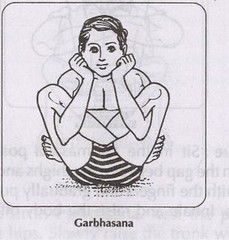
GARBHASANA – SITTING POSTURE
When this asana is performed, the pose achieved resembles that of a human foetus in the womb. So this asana is called Garbhasana.
Technique:
As a Kukkutasana, insert the hands between the thighs and the calves. Push the arms forward till the elbows can be easily bent. Then hold the lobe of the right ear with the right hand and of the left ear with the left hand. Stay in this position very cautiously to avoid tumbling. The constant practice of this asana will enable you to balance the body on the coccyx (the tail bone). If aspirants experience difficulty in performing this asana in Padmasana position, it should be practiced without Padmasana. While performing this asana, let the legs be stretched on the floor. The asana should be performed for 8 to 10 seconds in the beginning. Later, the time of the retention of the asana can be increased to one minute depending on age, ability of the aspirants and benefits expected.
Technique:
As a Kukkutasana, insert the hands between the thighs and the calves. Push the arms forward till the elbows can be easily bent. Then hold the lobe of the right ear with the right hand and of the left ear with the left hand. Stay in this position very cautiously to avoid tumbling. The constant practice of this asana will enable you to balance the body on the coccyx (the tail bone). If aspirants experience difficulty in performing this asana in Padmasana position, it should be practiced without Padmasana. While performing this asana, let the legs be stretched on the floor. The asana should be performed for 8 to 10 seconds in the beginning. Later, the time of the retention of the asana can be increased to one minute depending on age, ability of the aspirants and benefits expected.
UTTAMANGASANA
To practise Uttamangasana is not so easy as either Lolasana or kukkutasana. The body should be strong to practise this asana. Gymnasts can perform this asana very easily.
Technique : First sit in the position of padmsana. Then raise the knees and press them between the chest and the arms. Then raise the body with the force of the arms in such a way that the weight of the body falls on both the arms. While raising the body inhale and fill the lungs with air. Hold the breath. Exhale smoothly while coming to the original position. Gradually, incdrease the time for the practice of this asana. The limit is five minutes.
Advantages :
(1) This asana strengthens the joints and the muscles of the arms and the legs.
(2) As it eliminates the weakness of all the abdominal organs and the chest it is more important than Lolasana or kukkutasana.
(3) The regular practice of this asana roots out diseases like tuberculosis and asthma.
Technique : First sit in the position of padmsana. Then raise the knees and press them between the chest and the arms. Then raise the body with the force of the arms in such a way that the weight of the body falls on both the arms. While raising the body inhale and fill the lungs with air. Hold the breath. Exhale smoothly while coming to the original position. Gradually, incdrease the time for the practice of this asana. The limit is five minutes.
Advantages :
(1) This asana strengthens the joints and the muscles of the arms and the legs.
(2) As it eliminates the weakness of all the abdominal organs and the chest it is more important than Lolasana or kukkutasana.
(3) The regular practice of this asana roots out diseases like tuberculosis and asthma.
The Purification of The Body SHATKARMA Through Yoga
Prior to practising Yogasana,pranayama and meditation,it is desirable and also necessary to detoxify and purify the body.Toxic properties accumlate in the body for a number of reasons.If these toxins are not eliminated from the body,one would not get the desired benefits of Yogasana and Pranayama.
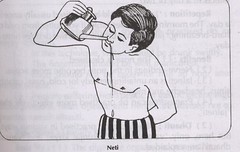
Neti :
There are various methods of doing 'neti' here,only Jalneti has been described.
For doing'Jalneti',a special kind of jug-'netilota'-is used.
Fill the jug with pure water.Add half a spoon of salt to it.First boil the water and then cool it.Stand in front of basin or in a mirror.Lower the head to the left side.Place the funnel of the jug into the right nostril.Further,lower the head slightly and raise the jug so that the water which entered the right nostril comes through the left nostril. Continue this 'Kriya' for a minute. Then take the funnel out of the right nostril.
Now place the funnel of the jug into the left nostril and lower the head to the right side so that the water which entered the left nostril may come out of the right nostril.Continue this'Kriya' for a minute.
Then sneeze fifteen to twenty times (breathing out forcefully from the nose) and let the water be evacuated from the nose.It is neccessary to make the nose dry.
Note:
(1) If the water comes into the mouth through the nostril,spit it,do not swallow it.
(2) There will be burning sensation in the nose and,with frequent sneezes,the eyes will fill with tears while doing 'Jalneti'. This is natural. You will be accustomed to these effects in a day or two.
Repetition:
'Jalneti' should be practised usually once in a day. The morning time is desirable. If you suffer from cold or hard-breathing,'Jalneti' may be practised two or three times a day.
Benefits:
(1) The nose is cleansed.
(2) Never-endings in the nose become more active.
(3) Jalneti is an unfailing remedy for cold,nasal catarrh,sinus,headache and migraine.
Neti :
There are various methods of doing 'neti' here,only Jalneti has been described.
For doing'Jalneti',a special kind of jug-'netilota'-is used.
Fill the jug with pure water.Add half a spoon of salt to it.First boil the water and then cool it.Stand in front of basin or in a mirror.Lower the head to the left side.Place the funnel of the jug into the right nostril.Further,lower the head slightly and raise the jug so that the water which entered the right nostril comes through the left nostril. Continue this 'Kriya' for a minute. Then take the funnel out of the right nostril.
Now place the funnel of the jug into the left nostril and lower the head to the right side so that the water which entered the left nostril may come out of the right nostril.Continue this'Kriya' for a minute.
Then sneeze fifteen to twenty times (breathing out forcefully from the nose) and let the water be evacuated from the nose.It is neccessary to make the nose dry.
Note:
(1) If the water comes into the mouth through the nostril,spit it,do not swallow it.
(2) There will be burning sensation in the nose and,with frequent sneezes,the eyes will fill with tears while doing 'Jalneti'. This is natural. You will be accustomed to these effects in a day or two.
Repetition:
'Jalneti' should be practised usually once in a day. The morning time is desirable. If you suffer from cold or hard-breathing,'Jalneti' may be practised two or three times a day.
Benefits:
(1) The nose is cleansed.
(2) Never-endings in the nose become more active.
(3) Jalneti is an unfailing remedy for cold,nasal catarrh,sinus,headache and migraine.
CHAKRASANA
In practicing this asana, the spine is twisted in such a way that the body forms a semicircular shape, hence this asana is called ‘Chakrasana’. It resembles a rainbow.Technique :
Lie flat on the back. Draw the legs in till the heels are close to the hips and the soles touch the ground. The gap between the legs should be of four to six inches. Bend the arms at the elbows and place them on the ground on either side of the head.
Raise the body from the waist to the hind part of the head as shown in the figures 2 and 3 breathe in the normal way. Tilt the head backwards as far as possible. Keep the hands straight. Keep the body steady. Do not shift either the arms or the legs from their positions. Raise the back as far as it allows it to do. (See figure 4). Remain in this position for about a minute. Then inhale and lower the body to the ground and bring it to the original position. Then breathe normally.
Advantages:
(1) Through this asana, an aspirant can make his spine quite elastic. Elasticity of the spine preserves youth for a very long time.
(2) This asana is an adjunct to Sarvangasana. When a long turn of Sarvangasana gives one a cramped neck or pain in the shoulders, a turn of Chakrasana helps to remove it. The reason is that the twist is on the backside.
(3)This asana has all the benefits of Dhanurasana, Shalabhasana and bhujangasana.
Labels:
chakrasana,
Yogasana
Sex and Yoga
Everybody's interested in sex. Whether it's to get pregnant, who's doing it and with whom, or how often is normal? We wonder what we should wear, or how much hair to remove to get more of it, or even how to market it? It's in our face in some way, often subliminally, and frequently in a distorted way every day. Men and women obviously have differing sexual needs, (not necessarily sex drives guys!), and this often leads to conflict. Conflict is the antithesis of yoga, yet within conflict there is always opportunity for unity. This is where yoga comes into play.
Sex and yoga is about harmony, about bringing balance into the equation so both sexes feel healthy, nourished and appreciated, free from all the usual repercussions or associated pressures. In my opinion the essence of sex is as a pathway to spiritual transformation and lasting physical well being. Basically yoga makes you feel good. It gets the blood pumping. It gets the hormones flushing through the body. It gives your skin a healthy youthful glow. It generates heat and stimulation from the inside out. It gives you energy, and that's sexy.
Sex and yoga are more intimately connected than we think. Sex feels good. Good sex with someone we love opens our hearts, makes us smile and relieves tension. Sex is about relationship, connection, intimacy, love and creative expression. At their best sex and yoga are about union, truth and love. To reveal those things in your life, your yoga practice, and your sex life takes a genuine commitment to creating a deeper sense of intimacy and overall wellbeing. In my journey as a yoga teacher I encourage all those things and created a yoga system as a way of putting it into a concise practice.
I use a unique system of corrective Japanese yoga postures, wholefood medicine and breath work, which has the potential to heal and enliven, stimulate and support both the sympathetic and parasympathetic nervous systems. When this happens, optimal function of our hormonal, lymphatic, circulatory, respiratory and digestive systems is restored. This makes us feel more vital, connected and present. We begin to engage more fully with life on all levels - mentally, emotionally, spiritually, physically and sexually.
To keep it simple: each section of our spine is governed by a particular meridian, and our very foundation, the sacrum, our base chakra into Mother Earth, dictates how secure, confident and trusting we feel within ourselves. Our sexual essence, that is, our base chakra or kundalini energy, is the connection between our Spirit and Universal Consciousness, or Love.
The flow of sexual hormones is governed primarily by our kidney energy and is intricately connected to our emotional health and how fluidly we move through life, and whether we speak our truth from our hearts and souls without fear. A strong aligned spine is the foundation channel for this universal energy so we can move through life, embrace challenges and grow into the full expression of ourselves.
Sex and yoga are therefore intricately entwined!
Our sexual and emotional confidence is governed by the quality of our Base chakra (perineum), Solar plexus chakra (navel) and Heart chakra. Yoga works to connect the potential in these chakras and energize the entire chakra system from the pelvic floor to our biggest sex organ, the brain. My female students have noticed marked improvement in their energy levels, regulation of, and reduced discomfort throughout their menstrual cycles, healthier hair and skin and a general sense of heightened vitality, libido and sexual responsiveness - all good things!
For women, the sequence will help correct gynaecological disorders, enhance fertility, counter osteoporosis, reduce varicose veins, rebuild pelvic floor integrity after childbirth (imperative on so many levels!), balance hormonal function and generally improve emotional and sexual confidence. My male students are honoured and nourished equally so they can start to access both their male and female energies (yin and yang) in an appropriate way to experience balance, intuition and emotional expression, rather than traditional repression.
They comment that they have become more empathetic with their partners and other men. They unravel learnt behaviours and stereotypes that stop them from feeling and being true to themselves, without losing their sense of masculinity. You can still be a bloke and sensitive. For men, the important issues of prostate health, virility/fertility, hair loss, libido, body confidence and stamina are addressed to help counter the effects of aging, modern day stresses and work and relationship pressures often placed upon them.
This ripples out into the greater community as energy of understanding, compassion, tolerance, self responsibility and positive response rather than reaction, and ultimately, respect for the opposite sex. These introductory postures take just 20 - 30 minutes a day and if possible should be done at least 3 times a week.
1: Gall Bladder Dips
Interlace hands behind head, R foot against L knee. Exhale and drop elbow to rear foot to open up opposite waist, draw elbows wide. Inhale to centre, repeat briskly x 8. Releases tight sides and brings softness to the shoulders & hips. Also releases the lines that govern the metabolism so we can maintain healthy weight and body image, plus tones the waist/hip line where we often store unresolved issues.
2: Spleen Bridge - Setu Bandha
Exhale and lift hips high, pressing through inside edge of feet. Inhale and lower one vertebra at a time to the mat. Repeat smoothly x 8, drawing knees in slightly to feel inner thigh line. Rest on back after and breathe - feel Spleen blood quality/pulsing up legs into belly. Upper body will soften and thoughts will relax as well as hormone flow improves. When we feel warm and nurtured from within this expresses as compassion and sensitivity towards ourselves and others. Spleen energy helps us make supportive choices & develops personal integrity so we don't repeat negative/destructive patterns in relation to ourselves or others.
3: Kidney/Spleen Lift
Lie on belly with L foot pressed into R inner knee, squeeze elbows into ribs. Exhale and lift hands and straight leg, pressing foot to knee and feeling the kidney area. Inhale and lower, repeat lifting x 6, then hold up and inhale. Exhale and squeeze around to L, lift chest and straight leg to draw awareness into weak points in lower back and increase blood flow and motivation into the kidneys. Inhale to centre, exhale and squeeze round to R. Swing L to R briskly x 10 then rest on belly with head to one side and breathe deeply.Stimulates endorphins and increases sexual vigor, builds libido and stamina.
4: Bow - Dhanurasana
Lie on belly and bend knees to hold ankles, forehead to mat. Exhale and lift into Bow, press belly into mat and resist feet with hands to open shoulders. Inhale and lower, rest briefly then repeat and hold up for 3-6 breaths. Relax and feel the lungs, heart and belly energies connecting. Excellent for reproductive organs, circulation and developing emotional sensitivity.
5: Downward Facing Dog - Adho Mukha Svanasana
Come onto all fours in Downward Dog (Adho Mukha Svanasana), hands shoulder width, feet hip width, bend knees if need too. Hold for 5 - 8 breaths, releasing the jaw and neck, lengthening the spine up to the tailbone and rolling the shoulders away from the ears. Downward Dog stretches the spine and nervous system channels to bring mental clarity, nourish the spine and nerves and counterpose to Dhanurasana. Downward Dog builds mental endurance, leg and arm strength and nourishes the endocrine system, strengthens the heart and builds overall health and organ function.
6: Triangle Pose - Trikonasana
Take legs one leg length apart, R foot heel dissects L arch, L toes turned in 30 degrees. Arms out to sides at shoulder height, spine long and legs engaged. Exhale and lean over R leg extending and lifting R arm to open R ribcage. Keep back foot grounded and belly drawn to spine. Lower R hand to shin and L fingers to ceiling in line with shoulder, look to floor or up along L fingertips. Hold and breathe 5 - 8 breaths, focusing on lengthening the spine, rotating the chest, extending the energy from the heart out into the fingertips and anchoring down into the legs. Come up to standing on an inhalation and switch feet to do the other side. Lay down on your back after for a few breaths to absorb the cleansing effect of the pose.
Trikonasana strengthens the legs, tones the abdominal organs, particularly the Liver, flushes the hormones and lymphatics and creates a sense of expansion, acceptance and patience. Clear Liver energy helps connect us with our inner wisdom and ability to see opportunities and make appropriate choices that support our direction and purpose in life.
7: Crocodile - Chaturanga
Lie on your belly, hands beside chest, toes tucked under and knees lifted off the mat so legs are elevated and parallel to the floor. Exhale and contract entire body to lift off the mat and squeeze from the belly out into the limbs. Keep elbows close to ribs, chest in line with elbows and elbows over the wrists. Hold up for 3 breaths then rest with head to one side.
Crocodile governs the lungs and helps develop breath capacity, mental stamina and a sense of empowerment. Strong lungs give us a sense of trust and positivity as we draw in nourishment and breathe out stagnancy. Healthy lungs fuel the blood with oxygen and regulate the nervous system which in turn makes us feel good and radiate vibrant, attractive energy.
8: Hara Bicycle
Lie on your back with legs long and hands interlaced behind the head. Exhale and draw R knee to chest, L elbow up and across to meet it. Feel the belly engage. Inhale to centre, exhale and swap sides. Briskly cycle to build your belly strength and tone your abdominal organs and harness inner strength. Hara bicycle connects the kidney and lung energies to circulate oxygen, adrenalin and promote production of fresh hormones. Hara (or belly centre) strength and integrity is essential to maintain optimal digestion and hormone balance. When we are disconnected from or congested in our bellies, we lose awareness of what is appropriate and inappropriate, on all levels.
9: Seated Butterfly - Baddhakonasana
Sit with soles together, knees wide and hands interlaced around edges of toes. Use hands against feet as traction to lift the chest and lengthen the spine. Close the eyes and focus on your breath at the end of your practice now, observing the shifts in your body and mind and getting a sense of the energies moving within. Baddhakonasana is an excellent hip opener that helps circulate fresh blood around the pelvis to nourish the reproductive organs. Sit quietly for 5 - 10 minutes, breathing in and out through the nose to calm the adrenals, drawing the breath down into the belly and sit bones so you feel grounded, nourished and calm. As always with any posture always move within a sharp-pain-free range of movement. If you feel uncomfortable with a posture just bring it back a little. Do remember though, you need to be fit for good sex so keep your practice going and enjoy Sex and Yoga.
Sex and yoga is about harmony, about bringing balance into the equation so both sexes feel healthy, nourished and appreciated, free from all the usual repercussions or associated pressures. In my opinion the essence of sex is as a pathway to spiritual transformation and lasting physical well being. Basically yoga makes you feel good. It gets the blood pumping. It gets the hormones flushing through the body. It gives your skin a healthy youthful glow. It generates heat and stimulation from the inside out. It gives you energy, and that's sexy.
Sex and yoga are more intimately connected than we think. Sex feels good. Good sex with someone we love opens our hearts, makes us smile and relieves tension. Sex is about relationship, connection, intimacy, love and creative expression. At their best sex and yoga are about union, truth and love. To reveal those things in your life, your yoga practice, and your sex life takes a genuine commitment to creating a deeper sense of intimacy and overall wellbeing. In my journey as a yoga teacher I encourage all those things and created a yoga system as a way of putting it into a concise practice.
I use a unique system of corrective Japanese yoga postures, wholefood medicine and breath work, which has the potential to heal and enliven, stimulate and support both the sympathetic and parasympathetic nervous systems. When this happens, optimal function of our hormonal, lymphatic, circulatory, respiratory and digestive systems is restored. This makes us feel more vital, connected and present. We begin to engage more fully with life on all levels - mentally, emotionally, spiritually, physically and sexually.
To keep it simple: each section of our spine is governed by a particular meridian, and our very foundation, the sacrum, our base chakra into Mother Earth, dictates how secure, confident and trusting we feel within ourselves. Our sexual essence, that is, our base chakra or kundalini energy, is the connection between our Spirit and Universal Consciousness, or Love.
The flow of sexual hormones is governed primarily by our kidney energy and is intricately connected to our emotional health and how fluidly we move through life, and whether we speak our truth from our hearts and souls without fear. A strong aligned spine is the foundation channel for this universal energy so we can move through life, embrace challenges and grow into the full expression of ourselves.
Sex and yoga are therefore intricately entwined!
Our sexual and emotional confidence is governed by the quality of our Base chakra (perineum), Solar plexus chakra (navel) and Heart chakra. Yoga works to connect the potential in these chakras and energize the entire chakra system from the pelvic floor to our biggest sex organ, the brain. My female students have noticed marked improvement in their energy levels, regulation of, and reduced discomfort throughout their menstrual cycles, healthier hair and skin and a general sense of heightened vitality, libido and sexual responsiveness - all good things!
For women, the sequence will help correct gynaecological disorders, enhance fertility, counter osteoporosis, reduce varicose veins, rebuild pelvic floor integrity after childbirth (imperative on so many levels!), balance hormonal function and generally improve emotional and sexual confidence. My male students are honoured and nourished equally so they can start to access both their male and female energies (yin and yang) in an appropriate way to experience balance, intuition and emotional expression, rather than traditional repression.
They comment that they have become more empathetic with their partners and other men. They unravel learnt behaviours and stereotypes that stop them from feeling and being true to themselves, without losing their sense of masculinity. You can still be a bloke and sensitive. For men, the important issues of prostate health, virility/fertility, hair loss, libido, body confidence and stamina are addressed to help counter the effects of aging, modern day stresses and work and relationship pressures often placed upon them.
This ripples out into the greater community as energy of understanding, compassion, tolerance, self responsibility and positive response rather than reaction, and ultimately, respect for the opposite sex. These introductory postures take just 20 - 30 minutes a day and if possible should be done at least 3 times a week.
1: Gall Bladder Dips
Interlace hands behind head, R foot against L knee. Exhale and drop elbow to rear foot to open up opposite waist, draw elbows wide. Inhale to centre, repeat briskly x 8. Releases tight sides and brings softness to the shoulders & hips. Also releases the lines that govern the metabolism so we can maintain healthy weight and body image, plus tones the waist/hip line where we often store unresolved issues.
2: Spleen Bridge - Setu Bandha
Exhale and lift hips high, pressing through inside edge of feet. Inhale and lower one vertebra at a time to the mat. Repeat smoothly x 8, drawing knees in slightly to feel inner thigh line. Rest on back after and breathe - feel Spleen blood quality/pulsing up legs into belly. Upper body will soften and thoughts will relax as well as hormone flow improves. When we feel warm and nurtured from within this expresses as compassion and sensitivity towards ourselves and others. Spleen energy helps us make supportive choices & develops personal integrity so we don't repeat negative/destructive patterns in relation to ourselves or others.
3: Kidney/Spleen Lift
Lie on belly with L foot pressed into R inner knee, squeeze elbows into ribs. Exhale and lift hands and straight leg, pressing foot to knee and feeling the kidney area. Inhale and lower, repeat lifting x 6, then hold up and inhale. Exhale and squeeze around to L, lift chest and straight leg to draw awareness into weak points in lower back and increase blood flow and motivation into the kidneys. Inhale to centre, exhale and squeeze round to R. Swing L to R briskly x 10 then rest on belly with head to one side and breathe deeply.Stimulates endorphins and increases sexual vigor, builds libido and stamina.
4: Bow - Dhanurasana
Lie on belly and bend knees to hold ankles, forehead to mat. Exhale and lift into Bow, press belly into mat and resist feet with hands to open shoulders. Inhale and lower, rest briefly then repeat and hold up for 3-6 breaths. Relax and feel the lungs, heart and belly energies connecting. Excellent for reproductive organs, circulation and developing emotional sensitivity.
5: Downward Facing Dog - Adho Mukha Svanasana
Come onto all fours in Downward Dog (Adho Mukha Svanasana), hands shoulder width, feet hip width, bend knees if need too. Hold for 5 - 8 breaths, releasing the jaw and neck, lengthening the spine up to the tailbone and rolling the shoulders away from the ears. Downward Dog stretches the spine and nervous system channels to bring mental clarity, nourish the spine and nerves and counterpose to Dhanurasana. Downward Dog builds mental endurance, leg and arm strength and nourishes the endocrine system, strengthens the heart and builds overall health and organ function.
6: Triangle Pose - Trikonasana
Take legs one leg length apart, R foot heel dissects L arch, L toes turned in 30 degrees. Arms out to sides at shoulder height, spine long and legs engaged. Exhale and lean over R leg extending and lifting R arm to open R ribcage. Keep back foot grounded and belly drawn to spine. Lower R hand to shin and L fingers to ceiling in line with shoulder, look to floor or up along L fingertips. Hold and breathe 5 - 8 breaths, focusing on lengthening the spine, rotating the chest, extending the energy from the heart out into the fingertips and anchoring down into the legs. Come up to standing on an inhalation and switch feet to do the other side. Lay down on your back after for a few breaths to absorb the cleansing effect of the pose.
Trikonasana strengthens the legs, tones the abdominal organs, particularly the Liver, flushes the hormones and lymphatics and creates a sense of expansion, acceptance and patience. Clear Liver energy helps connect us with our inner wisdom and ability to see opportunities and make appropriate choices that support our direction and purpose in life.
7: Crocodile - Chaturanga
Lie on your belly, hands beside chest, toes tucked under and knees lifted off the mat so legs are elevated and parallel to the floor. Exhale and contract entire body to lift off the mat and squeeze from the belly out into the limbs. Keep elbows close to ribs, chest in line with elbows and elbows over the wrists. Hold up for 3 breaths then rest with head to one side.
Crocodile governs the lungs and helps develop breath capacity, mental stamina and a sense of empowerment. Strong lungs give us a sense of trust and positivity as we draw in nourishment and breathe out stagnancy. Healthy lungs fuel the blood with oxygen and regulate the nervous system which in turn makes us feel good and radiate vibrant, attractive energy.
8: Hara Bicycle
Lie on your back with legs long and hands interlaced behind the head. Exhale and draw R knee to chest, L elbow up and across to meet it. Feel the belly engage. Inhale to centre, exhale and swap sides. Briskly cycle to build your belly strength and tone your abdominal organs and harness inner strength. Hara bicycle connects the kidney and lung energies to circulate oxygen, adrenalin and promote production of fresh hormones. Hara (or belly centre) strength and integrity is essential to maintain optimal digestion and hormone balance. When we are disconnected from or congested in our bellies, we lose awareness of what is appropriate and inappropriate, on all levels.
9: Seated Butterfly - Baddhakonasana
Sit with soles together, knees wide and hands interlaced around edges of toes. Use hands against feet as traction to lift the chest and lengthen the spine. Close the eyes and focus on your breath at the end of your practice now, observing the shifts in your body and mind and getting a sense of the energies moving within. Baddhakonasana is an excellent hip opener that helps circulate fresh blood around the pelvis to nourish the reproductive organs. Sit quietly for 5 - 10 minutes, breathing in and out through the nose to calm the adrenals, drawing the breath down into the belly and sit bones so you feel grounded, nourished and calm. As always with any posture always move within a sharp-pain-free range of movement. If you feel uncomfortable with a posture just bring it back a little. Do remember though, you need to be fit for good sex so keep your practice going and enjoy Sex and Yoga.
Benefits Of Yoga Balancing
Most of us suffer from problems of asymmetry and imbalance. The irregularity and imbalance create a lot of stress and strain in our body. At times, it also leads to injury, pain, or just simple discomfort. If you are also one amongst the sufferers, do not worry. Just turn to Yoga. Yoga creates symmetry throughout your body, making you stronger, flexible and balanced. It also draws a balance between the mental urge to push, control and be assertive, with the impulse to yield, submit and be passive. Practicing the various asans, concentrating and meditation improves the overall being of an individual.
Benefits Of Yoga:
Improvement in balance is one of the major benefits of Yoga. Improved balance is referred not only to the sharp physical coordination, but also to the balance between the left and right, front and back and high and low aspects of one's body. As far as balance of the body is concerned, hardly few of us have proper balance. We may be stronger on one side, but definitely fall short of strength when it comes to the other side. The same is also seen, while turning or twisting the head. Whilst we can easily twist or turn on one side, the other is always a problem. Also, though most of can bend forward with ease, bending backwards is a big problem.
Yoga helps us attain hormonal balance, by producing a nice positive charge. This is important from the female point of view, especially for pre-menopausal and menopausal women, who want to find ways to balance their hormones naturally. To attain good balance, you need not be physically strong, but also have the mental agility to focus on your posture. There are a number of asanas that aim at achieving balance in the body. One of them is 'Tadasana' or mountain pose, which requires you to stand straight with your legs slightly apart and eyes closed. It would help you realize, which side of your body is more powerful and where do you tend to concentrate your weight on.
After performing 'Tadasana', you can perform the one-legged stand. This is generally done to achieve center balance. The longer the duration of the pose, the better are the chances of improving balance. Another effective asan is the 'Vrksasana' or tree pose. It strengthens the leg and calf muscles, making it easier to balance the body. 'Matsyasana' or fish pose asan is also beneficial for postural alignment. In this particular asan, you lie down on your back forming an arching. This helps in the curvature of your spine, making it more flexible and longer.
However, before performing any of the asan mentioned above, you should learn the proper techniques from a trained instructor. Remember, proper Yoga practice ensures not only physical balance, but also emotional and spiritual balance.
Benefits Of Yoga:
Improvement in balance is one of the major benefits of Yoga. Improved balance is referred not only to the sharp physical coordination, but also to the balance between the left and right, front and back and high and low aspects of one's body. As far as balance of the body is concerned, hardly few of us have proper balance. We may be stronger on one side, but definitely fall short of strength when it comes to the other side. The same is also seen, while turning or twisting the head. Whilst we can easily twist or turn on one side, the other is always a problem. Also, though most of can bend forward with ease, bending backwards is a big problem.
Yoga helps us attain hormonal balance, by producing a nice positive charge. This is important from the female point of view, especially for pre-menopausal and menopausal women, who want to find ways to balance their hormones naturally. To attain good balance, you need not be physically strong, but also have the mental agility to focus on your posture. There are a number of asanas that aim at achieving balance in the body. One of them is 'Tadasana' or mountain pose, which requires you to stand straight with your legs slightly apart and eyes closed. It would help you realize, which side of your body is more powerful and where do you tend to concentrate your weight on.
After performing 'Tadasana', you can perform the one-legged stand. This is generally done to achieve center balance. The longer the duration of the pose, the better are the chances of improving balance. Another effective asan is the 'Vrksasana' or tree pose. It strengthens the leg and calf muscles, making it easier to balance the body. 'Matsyasana' or fish pose asan is also beneficial for postural alignment. In this particular asan, you lie down on your back forming an arching. This helps in the curvature of your spine, making it more flexible and longer.
However, before performing any of the asan mentioned above, you should learn the proper techniques from a trained instructor. Remember, proper Yoga practice ensures not only physical balance, but also emotional and spiritual balance.
Help Cure or Prevent Backaches with Yoga
For many centuries, people have used yoga for a number of different reasons. Whilst in the beginning yoga was mainly used for spiritual reasons, in more recent years, it has started to be used for therapeutic purposes. For instance, people with back troubles will generally search for some form of exercise that will assist them with their condition. Yoga tends to be a beneficial exercise for relief of many forms of pain for a number of reasons. Can yoga help to relieve your back pain? Potentially yes, and here are a few reasons as to why it could help you.
One of the main benefits of yoga is that it allows your body to become more supple. There are several different stretching exercises that are involved in yoga and these exercises are able to help your back in an astounding way. Naturally, you need to be careful that you don’t over do things, especially dependant upon the type of back injury/pain that you are experiencing. For the majority of people, however, a small amount of yoga can really assist you with being more comfortable and perhaps even help to overcome the back pain that you are experiencing altogether. As well as helping to relieve back pain, yoga can also aid you with a number of other benefits, from performing these types of stretching exercises.
One such way that yoga can help, is by reaching the core of the problem. One of the reasons that many people suffer from backache, is because the core of their body is either out of shape or out of alignment. This could be due to either a lack of exercise or perhaps from being slightly overweight.
It might also be a combination of issues that can be resonating from the core of the body. Yoga exercises are designed to help strengthen the core, which can really benefit the back. You may have heard it said that in order for you to strengthen your back, you need to strengthen your abdominal muscles.This is basically the same principle.
One final way that yoga may assist you with backaches is by helping to prevent the pain from reoccurring again. This is achieved through both the stretching exercises and by strengthening the core muscles. By continuing and practising these stretching exercises, you will soon discover that you are able to do things that you were unable to do before. You will find that it’s a great relief to be able to go about your day to day life without having to worry as much about throwing your back out.
One of the main benefits of yoga is that it allows your body to become more supple. There are several different stretching exercises that are involved in yoga and these exercises are able to help your back in an astounding way. Naturally, you need to be careful that you don’t over do things, especially dependant upon the type of back injury/pain that you are experiencing. For the majority of people, however, a small amount of yoga can really assist you with being more comfortable and perhaps even help to overcome the back pain that you are experiencing altogether. As well as helping to relieve back pain, yoga can also aid you with a number of other benefits, from performing these types of stretching exercises.
One such way that yoga can help, is by reaching the core of the problem. One of the reasons that many people suffer from backache, is because the core of their body is either out of shape or out of alignment. This could be due to either a lack of exercise or perhaps from being slightly overweight.
It might also be a combination of issues that can be resonating from the core of the body. Yoga exercises are designed to help strengthen the core, which can really benefit the back. You may have heard it said that in order for you to strengthen your back, you need to strengthen your abdominal muscles.This is basically the same principle.
One final way that yoga may assist you with backaches is by helping to prevent the pain from reoccurring again. This is achieved through both the stretching exercises and by strengthening the core muscles. By continuing and practising these stretching exercises, you will soon discover that you are able to do things that you were unable to do before. You will find that it’s a great relief to be able to go about your day to day life without having to worry as much about throwing your back out.
PADAHASTASANA
If 'Pashchimottanasana' is attained in a standing posture, it becomes a different Yogic exercise known as 'Padahastasana'. This asana is also called 'Sthita Pashchi mottanasana'. Some people call it 'Hastapada Mangasana'.
Technique :
Stand erect. Keep the arms by the sides. Keep the heels close together. Keep some gap between the feet. Raise both the arms. Slowly bend forward at the waist. Keep the knees stiff and firm. The legs should not bend at the knees. Also do not let the arms bend at the elbows. Keep the palms under the feet as shown in the figure. Slowly exhale while bending low and contract the stomach. Now put your forehead between the knees. If it is difficult to bend low because of fat around the abdomen, try to bend the body slowly; do not bend the knees. Hold this position for two to ten seconds.
Advantages :
(1) This asana removes the superfluous fat from the body making the body light.
(2) It has all the benefits of Pashchimottanasana.
(3) It directs the 'apanvayu' downwards and out at the anus.
(4)It rectifies any unevenness in length in the leg owing to the fracture of any bones either in the leg or the thigh.
Technique :
Stand erect. Keep the arms by the sides. Keep the heels close together. Keep some gap between the feet. Raise both the arms. Slowly bend forward at the waist. Keep the knees stiff and firm. The legs should not bend at the knees. Also do not let the arms bend at the elbows. Keep the palms under the feet as shown in the figure. Slowly exhale while bending low and contract the stomach. Now put your forehead between the knees. If it is difficult to bend low because of fat around the abdomen, try to bend the body slowly; do not bend the knees. Hold this position for two to ten seconds.
Advantages :
(1) This asana removes the superfluous fat from the body making the body light.
(2) It has all the benefits of Pashchimottanasana.
(3) It directs the 'apanvayu' downwards and out at the anus.
(4)It rectifies any unevenness in length in the leg owing to the fracture of any bones either in the leg or the thigh.
Labels:
Padahastasana,
Yogasana
TRIKONASANA
When the final position is struck in this Yogic exercise, the body of the performer resembles a triangle, hence the name Trikonasana. The figures of its four positions have been given below to explain the right technique of this asana.
Technique :
Stand erect keeping a distance of about 75 cms between the feet. Stretch the arms sideways. Then raise them to the level of the shoulders. Let the palms face the ground. Stand erect.
(See figure 1).
Then bend the trunk to the left side and touch the left toes with the left hand. Stretch the right arm upwards and straighten it. Keep the eyes fixed on the right arm. Bring the left hand near the left toe.
(See figure 2).
Keep the left hand in the same position and rotate the right arm from over the waist and bring it to the head level. Look downward.
(See figure 3).
Then touch the right toes with the right hand. This is the final position of Trikonasana.
(See figure 4).
Rest for five to ten seconds and repeat this exercise with the right arm upside and the left arm upside. Hold each position for two seconds. Practice this asana four or five times a day.
Advantages :
(1) This asana relieves the stiffness of the neck.
(2) It relieves the pain in the joints of the neck and the shoulders. It also exercises the spinal cord, the hips, the thighs, the arms and the fingers.
(3) It makes the spine flexible and develops the mental power. This asana is also beneficial to the eyes.
Technique :
Stand erect keeping a distance of about 75 cms between the feet. Stretch the arms sideways. Then raise them to the level of the shoulders. Let the palms face the ground. Stand erect.
(See figure 1).
Then bend the trunk to the left side and touch the left toes with the left hand. Stretch the right arm upwards and straighten it. Keep the eyes fixed on the right arm. Bring the left hand near the left toe.
(See figure 2).
Keep the left hand in the same position and rotate the right arm from over the waist and bring it to the head level. Look downward.
(See figure 3).
Then touch the right toes with the right hand. This is the final position of Trikonasana.
(See figure 4).
Rest for five to ten seconds and repeat this exercise with the right arm upside and the left arm upside. Hold each position for two seconds. Practice this asana four or five times a day.
Advantages :
(1) This asana relieves the stiffness of the neck.
(2) It relieves the pain in the joints of the neck and the shoulders. It also exercises the spinal cord, the hips, the thighs, the arms and the fingers.
(3) It makes the spine flexible and develops the mental power. This asana is also beneficial to the eyes.
Labels:
Trikonasana,
Yogasana
Most Americans Think It's Others Who Are Unhealthy
Despite rising rates of obesity and diabetes, a new survey has found that a majority of Americans believe their health is just fine - it's everyone else who has the problem.
More than 50 percent of respondents said that other people's health "was going in the wrong direction." In contrast, only 17 percent said their own health was going in the wrong direction.
Commissioned by GE Healthcare, The Cleveland Clinic and Ochsner Health System, the survey looked at how Americans and their health-care professionals rate the country's health. The findings, which were released Tuesday, show a big disconnect between how Americans rate their own personal health and how they rate the health of their fellow Americans. Furthermore, Americans seem to think they are in much better shape than their doctors believe they are.
"Either people are denying reality about themselves or they don't have the correct knowledge and believe they are doing the right things," said study author Dr. Michael Roizen, chairman of The Cleveland Clinic's Wellness Institute. "Personally, I think there is a lot of misinformation [about healthy habits]."
On the other hand, Roizen added, many physicians may be overstating their concern about the health of the general population because they tend to see the sickest.
According to the study, which surveyed more than 2,000 people across the United States late last year:
1. Nearly 30 percent of the respondents gave themselves an A for managing their personal health, while 92 percent of doctors gave them a C or lower.
2. Nearly a third of the study respondents gave themselves an A for eating healthy. Once again, 92 percent of doctors gave them a C or lower.
3. About a third gave themselves an A for getting regular exercise, while 91 percent of physicians gave them a C or lower.
One disconnect is that in a land where a majority of people are overweight or obese, people tend to compare themselves favorably with their more overweight neighbors, explained Eva To, a registered dietician in White Plains, N.Y.
"Everything is relative," she said. "In America, everything is big. But if you put them in an Asian country, they will compare themselves to someone else."
Another problem seems to be that many respondents didn't know their basic health numbers - blood pressure, cholesterol, glucose level and other measures. Just 24 percent knew their body-mass index; 29 percent knew their blood glucose level; 33 percent knew their daily caloric intake; and only 36 percent knew their current cholesterol levels.
And yet a majority reported that keeping those numbers in a good range was key to good health. Ninety-five percent agreed that regular checkups with their physicians were important, even though 70 percent said they had taken actions to avoid their doctors, such as hoping their health problems would go away on their own or asking a friend for medical advice instead.
"It is important that patients communicate with their personal physicians to help manage their own health," said Dr. Scott Hayworth, president and CEO of Mount Kisco Medical Group in New York. "With this comes an obligation to be aware of how well they are following guidelines for exercise, diet and weight management."
It's a task that may be easier said than done, according to To.
"Americans are just not into prevention," she said. "If they are not sick, they think they are healthy. But most of the killers are silent diseases, such as diabetes, high blood pressure and hardening of the arteries. We don't feel it, but they are killers all the same."
People also tend to rationalize their bad behavior by believing that the good things they do cancel out the negative. An extra slice of pizza, for example, may be justified as OK after a workout.
"People may say they eat salad for lunch, but what about the salad dressing?" said To. "They look at one element and not look at the whole picture."
More than 50 percent of respondents said that other people's health "was going in the wrong direction." In contrast, only 17 percent said their own health was going in the wrong direction.
Commissioned by GE Healthcare, The Cleveland Clinic and Ochsner Health System, the survey looked at how Americans and their health-care professionals rate the country's health. The findings, which were released Tuesday, show a big disconnect between how Americans rate their own personal health and how they rate the health of their fellow Americans. Furthermore, Americans seem to think they are in much better shape than their doctors believe they are.
"Either people are denying reality about themselves or they don't have the correct knowledge and believe they are doing the right things," said study author Dr. Michael Roizen, chairman of The Cleveland Clinic's Wellness Institute. "Personally, I think there is a lot of misinformation [about healthy habits]."
On the other hand, Roizen added, many physicians may be overstating their concern about the health of the general population because they tend to see the sickest.
According to the study, which surveyed more than 2,000 people across the United States late last year:
1. Nearly 30 percent of the respondents gave themselves an A for managing their personal health, while 92 percent of doctors gave them a C or lower.
2. Nearly a third of the study respondents gave themselves an A for eating healthy. Once again, 92 percent of doctors gave them a C or lower.
3. About a third gave themselves an A for getting regular exercise, while 91 percent of physicians gave them a C or lower.
One disconnect is that in a land where a majority of people are overweight or obese, people tend to compare themselves favorably with their more overweight neighbors, explained Eva To, a registered dietician in White Plains, N.Y.
"Everything is relative," she said. "In America, everything is big. But if you put them in an Asian country, they will compare themselves to someone else."
Another problem seems to be that many respondents didn't know their basic health numbers - blood pressure, cholesterol, glucose level and other measures. Just 24 percent knew their body-mass index; 29 percent knew their blood glucose level; 33 percent knew their daily caloric intake; and only 36 percent knew their current cholesterol levels.
And yet a majority reported that keeping those numbers in a good range was key to good health. Ninety-five percent agreed that regular checkups with their physicians were important, even though 70 percent said they had taken actions to avoid their doctors, such as hoping their health problems would go away on their own or asking a friend for medical advice instead.
"It is important that patients communicate with their personal physicians to help manage their own health," said Dr. Scott Hayworth, president and CEO of Mount Kisco Medical Group in New York. "With this comes an obligation to be aware of how well they are following guidelines for exercise, diet and weight management."
It's a task that may be easier said than done, according to To.
"Americans are just not into prevention," she said. "If they are not sick, they think they are healthy. But most of the killers are silent diseases, such as diabetes, high blood pressure and hardening of the arteries. We don't feel it, but they are killers all the same."
People also tend to rationalize their bad behavior by believing that the good things they do cancel out the negative. An extra slice of pizza, for example, may be justified as OK after a workout.
"People may say they eat salad for lunch, but what about the salad dressing?" said To. "They look at one element and not look at the whole picture."
Labels:
Health
Hatha Yoga Practice Lessens Fear Of Falling In Older Adults, Study Suggests
Indiana University researchers found promising results in an exploratory study involving yoga practice by older adults who expressed a fear of falling. After a 12-week, twice weekly hatha yoga class, taught by a professional yoga therapist, study participants reported a reduced fear of falling, increased lower body flexibility and a reduction in their leisure constraints.
Fear of falling is an important public health concern because it can cause older adults -- even those who have not fallen -- to limit their social and physical activity. This effort to avoid falls can create a harmful cycle that can diminish health and quality of life.
"Our study found that yoga was a feasible intervention with older adults and that they perceived great benefit from it," said Marieke Van Puymbroeck, assistant professor in the Department of Recreation, Park and Tourism Studies in IU's School of Health, Physical Education and Recreation.
Van Puymbroeck discussed some of her findings this month at the International Association of Yoga Therapists' Symposium for Yoga Therapy and Research in Los Angeles and will discuss her findings further at conferences hosted by the American Geriatrics Society and the American Therapeutic Recreation Association. More about the study:
The study involved 14 men and women with an average age of 78. Five participants had fallen previously.
1. Van Puymbroeck said the 90 percent weekly attendance rate was notable, as was the 6 percent dropout rate, which she said was much lower than most physical activity and yoga studies. The participants took a class in hatha yoga, which is a gentle form of yoga that easily can be adapted for individual needs and can be performed from a seated position. The twice weekly classes each lasted 60 minutes.
2. After the 12-week class, participants reported a 6 percent reduction in their fear of falling, a 34 percent increase in lower body flexibility, and a statistically significant reduction in leisure constraints.
3. Van Puymbroeck said participants reported "tremendous benefits," with emerging themes that included the ability to generalize principals of posture to other situations, increased range of motion, increased flexibility and improved balance.
Co-investigators include David Koceja, Department of Kinesiology in IU Bloomington's School of HPER; and Arlene Schmid, Department of Occupational Therapy and Department of Veterans Affairs, Indiana University-Purdue University Indianapolis.
Fear of falling is an important public health concern because it can cause older adults -- even those who have not fallen -- to limit their social and physical activity. This effort to avoid falls can create a harmful cycle that can diminish health and quality of life.
"Our study found that yoga was a feasible intervention with older adults and that they perceived great benefit from it," said Marieke Van Puymbroeck, assistant professor in the Department of Recreation, Park and Tourism Studies in IU's School of Health, Physical Education and Recreation.
Van Puymbroeck discussed some of her findings this month at the International Association of Yoga Therapists' Symposium for Yoga Therapy and Research in Los Angeles and will discuss her findings further at conferences hosted by the American Geriatrics Society and the American Therapeutic Recreation Association. More about the study:
The study involved 14 men and women with an average age of 78. Five participants had fallen previously.
1. Van Puymbroeck said the 90 percent weekly attendance rate was notable, as was the 6 percent dropout rate, which she said was much lower than most physical activity and yoga studies. The participants took a class in hatha yoga, which is a gentle form of yoga that easily can be adapted for individual needs and can be performed from a seated position. The twice weekly classes each lasted 60 minutes.
2. After the 12-week class, participants reported a 6 percent reduction in their fear of falling, a 34 percent increase in lower body flexibility, and a statistically significant reduction in leisure constraints.
3. Van Puymbroeck said participants reported "tremendous benefits," with emerging themes that included the ability to generalize principals of posture to other situations, increased range of motion, increased flexibility and improved balance.
Co-investigators include David Koceja, Department of Kinesiology in IU Bloomington's School of HPER; and Arlene Schmid, Department of Occupational Therapy and Department of Veterans Affairs, Indiana University-Purdue University Indianapolis.
Labels:
Hatha Yoga,
Yogasana
Kapalbhati Pranayama (Cleansing Breathing Exercise) Step by Step and Shining Face

What we do in Kapalbhati Pranayama
In Kapalabhati we do quick exhalation and natural inhalation. Normally exhalation takes one fourth of the time of inhalation. Quick exhalation and natural inhalation follow each other.
How to do Kapalbhati Pranayama
Step 1) Sit in comfortable crossed leg position with Back straight. Hands resting on knees in either chin or gyana mudra. Face to be relaxed.Step 2) Inhale deeply through both nostril, expanding abdomen and exhale with the forceful contraction of abdominal muscles. (Pull the abdomen in by quickly contracting the abdominal muscles and exhale through the nose). The air is pushed out of lungs by contraction of the diaphragm.
Step 3) After exhalation again inhalation but inhalation should not involve any effort. To inhale just relax and the lungs will automatically expand and filled with air.
One can begin with 15 respiration. After completing 15 quick exhalation and natural inhalation , inhale and exhale deeply. This is one round.One can start the practice of Kapalbhati pranayama with 3 such rounds for practice.
Benefits of Kapalabhati
1) Kapalabhati cleanses the lungs and entire respiratory system.2) The blood is purified and body gets an increased supply of oxygen to all cells.
3) Digestion is improved.
4) Abdominal muscles are strengthened.
5) Prepare the mind for meditation.
6) Energise the mind for mental work.
Precautions:
Kapalbhati should not be practice by those
a) Suffering from heart disease
b) High blood pressure
c) Hernia
d) Should never be practiced when an asthmatic attack is in progress.
e) If pain or dizziness is experienced ,it is preferable to stop the practice till the sensation has passed. Practiced can be restarted with less force.
f) Quick exhalation should be comfortable to oneself. i.e. quick exhalation should not be too forceful.
Common Mistake:
1) Abdomen is contracted while inhaling.
2) Shoulders are contracted to push the air out when exhaling.
3) Back and shoulders move during exercise.
Point to Note:
a) Exercise should not be done if you are feeling uncomfortable at any time during the exercise.
b) Rapid breathing used in this technique should be from the abdomen and not from the chest.
c) Kapalbhati should be practice on an empty stomach only.
d) Kapalbhati should be practiced after the asanas and Relaxation (atleast 10 minutes) and before meditation e) Chest should not move very much.
f) It is always good and advisable that this exercise should be learned under supervision of yoga teacher after discussion with him about your health
Subscribe to:
Posts (Atom)